

In 2026, Optimizely's Marketer's Survival Guide found that 64% of marketers spend most of their time responding to short-term requests instead of planning ahead. I see the same pattern play out in marketing retainers. Hours get used. Tasks get closed. But when the quarter ends, nobody can point to what moved.
One time, a client came to me unsure what their bucketed project hours were producing. As their Program Manager (PM), I put together a short breakdown as a separate tab in their flight plan, showing exactly where their hours went and what each piece of work produced. It answered the question, but it also showed me that clients shouldn't have to ask it in the first place.
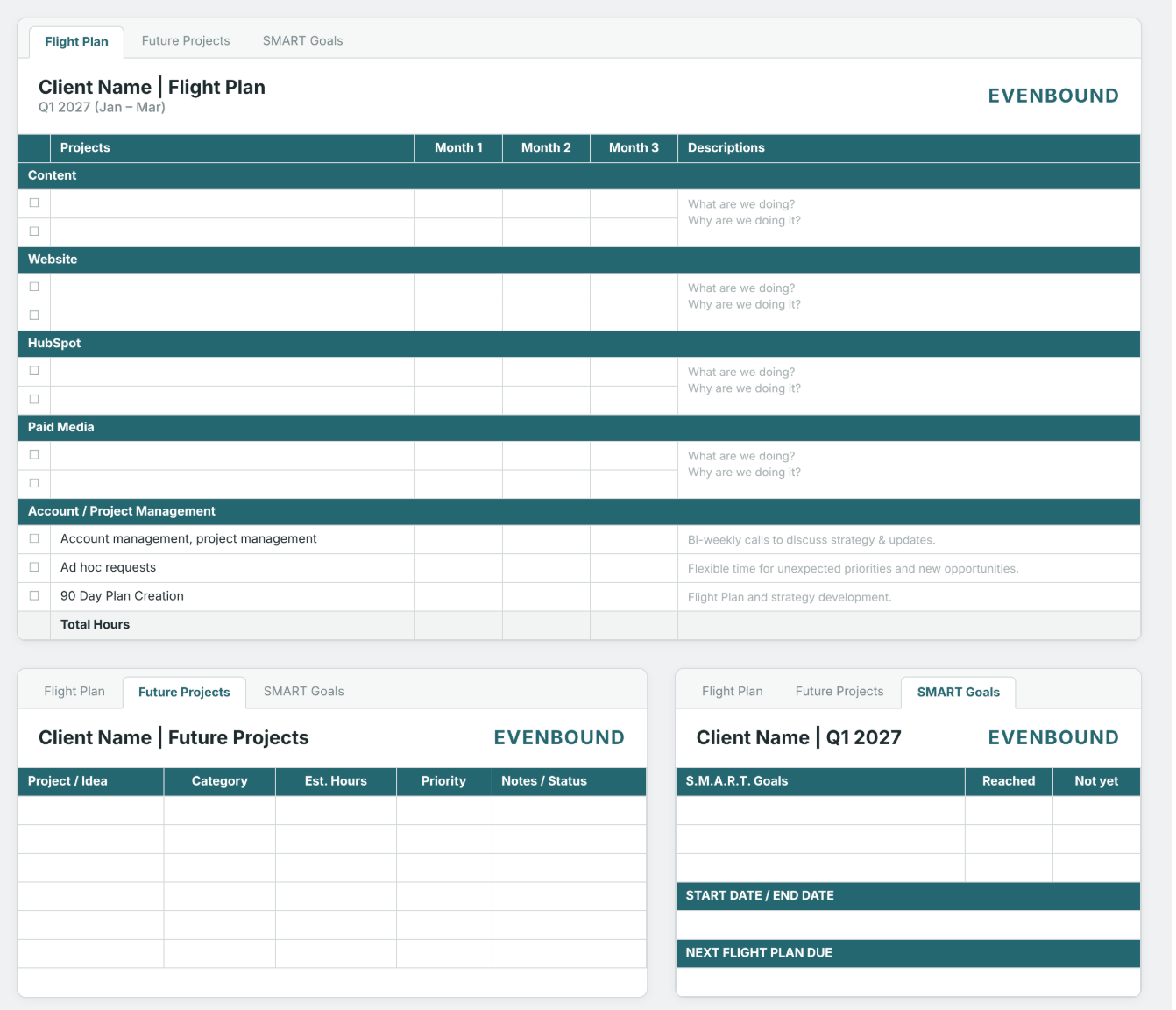
Flight Plan: A quarterly planning document that connects a retainer's hours to specific goals. It includes an hours and scope breakdown, a Future Projects list, and SMART goals for the quarter.
That's why I plan every client's retainer by quarter. A quarterly plan ties your hours to goals and gives the "not yet" ideas a place to wait. Here's how that planning works, and what you should expect from any partner managing your retainer.
Key Takeaways
- Only 50% of projects fully meet today's definition of success, according to PMI's 2025 Step Up report.
- Plan retainer work by quarter, starting with goals instead of task lists.
- Split hours into buckets and protect a buffer for ad-hoc requests.
- Park good ideas on a Future Projects list instead of squeezing them in.
Why Do Marketing Retainers Drift Without a Quarterly Plan?
Retainers drift because hours go to whatever is loudest that week instead of what matters most that quarter. Nobody decides to waste hours. They get spread thin one seemingly reasonable request at a time.
In 2026, Optimizely's Marketer's Survival Guide also found that 54% of marketers move from campaign to campaign without enough time to evaluate performance. On a retainer, that shows up in a few ways: maintenance work quietly fills the month, one-off requests stack up, and the bigger initiatives you hired a partner for never get started.
Retainer drift happens when monthly hours are spent on reactive requests and routine maintenance instead of the goals the retainer was meant to support. It's rarely one bad decision. It's dozens of small, reasonable ones made without a shared plan, which is why a quarterly plan tied to goals is the most reliable fix.
Have you ever looked at a monthly hours report and wondered how any of it connects to revenue? That's drift, and it's the problem our Team-as-a-Service partnership is built to solve.
What Is a Quarterly Flight Plan?
A flight plan is the one-page plan we build with each client at the start of every quarter. It shows where retainer hours are going those months, what's waiting for later, and how we'll measure success.
Flight Plan: A quarterly planning document that connects a retainer's hours to specific goals. It includes an hours and scope breakdown, a Future Projects list, and SMART goals for the quarter.
The Three Parts of a Flight Plan:
|
Component |
What it tells you |
Example |
|
Hours and scope |
Where this quarter's hours are going |
[e.g., X hrs reporting, X hrs campaigns, X hrs HubSpot improvements] |
|
Future Projects |
What's next, but not now |
[e.g., lead scoring rebuild, new integration] |
|
SMART goals |
How you'll measure success at quarter's end |
[e.g., increase MQL-to-SQL rate by X% by end of quarter] |
How Should Your Retainer Hours Be Split Across Priorities?
Your hours should be split based on the quarter's goals first, then grouped into buckets that serve those goals, with a buffer held back for requests nobody can predict.
Start With Goals, Not Tasks
A task list tells you what's getting done. Goals tell you why. When I start planning a quarter with a client, the first question isn't "What do you need this quarter?" It's "What needs to be true by the end of the quarter?" Every hour gets assigned from there.
Group Hours Into Buckets
Buckets make your retainer readable at a glance. Most of the plans I build use some version of these:
- Ongoing and maintenance: reporting, list cleanup, and routine updates
- Campaigns and content tied to this quarter's goals
- System improvements: new workflows, dashboards, and HubSpot builds
- Buffer: reactive requests that come up during the quarter
Protect the Buffer
The buffer keeps one urgent request from wiping out planned work. Without it, every rush job comes out of the bigger projects. With it, you get flexibility without losing momentum.
What Belongs on the Future Projects List?
Anything valuable that doesn't fit this quarter's hours or goals belongs on the Future Projects list. It keeps good ideas from getting lost, and it keeps them from quietly pulling hours away from current priorities.
When a new idea comes up, I run it through three quick questions:
- Does it support a goal we set this quarter?
- Does it fit in the hours we have left?
- Are its dependencies ready, like clean data, approvals, or connected systems?
If the answer to any of those is no, it goes on the list. That isn't a rejection. It's a decision about timing.
That's the whole idea behind the Future Projects tab in our flight plans. When a client brings us an idea that isn't a priority yet, we capture it there instead of rushing it into the current quarter. When it comes up for a future quarter, we can put real time and thought into planning it, and we can staff it with the right people instead of pulling in whoever happens to be free. The project that comes out the other side is better planned and better resourced than anything we could have squeezed in mid-quarter.
A Future Projects list prevents scope creep by giving new ideas a documented place to wait instead of forcing an immediate yes or no. Ideas on the list get re-ranked at each quarterly review, so the best ones move into the next plan with the right hours, goals, and preparation behind them.
The list also makes budget conversations easier. When leadership asks what more you could get done with more support, you already have a ranked answer.
I wrote about scope creep on one-time projects in 5 common project management pitfalls in HubSpot implementations. On a retainer, the Future Projects list does that job.
What Happens When Priorities Change Mid-Quarter?
When priorities change mid-quarter, you trade instead of add. A new priority replaces something of equal hours, and the swap gets documented in the plan.
Priorities will change. In 2025, PMI's Step Up report found that 35% of executives see the gap between planning and execution as their biggest obstacle. A plan that can't absorb change becomes a document nobody opens. A plan with a clear trade rule stays useful all quarter.
We also review hours used against hours planned at monthly check-ins, so a shift never shows up as a surprise at the end of the quarter.
How to Measure Success at the End of Each Quarter
Measure success by reviewing each SMART goal against actual results, comparing planned hours to actual hours, and carrying what you learned into the next flight plan.
Every quarterly review should give you:
- Each goal next to its result
- Planned versus actual hours by bucket
- What worked, what didn't, and why
- A re-ranked Future Projects list for next quarter
Some results take more than a quarter to show up. A new HubSpot workflow or dashboard only pays off once your team uses it consistently, which is why we track adoption instead of assuming it. (If that's where you're stuck, here's why HubSpot implementations often don't stick and how to fix it.)

Get More From Your Retainer Every Quarter
A retainer turns into results when the hours have a plan behind them: goals first, hours in buckets, a home for "later," and trades instead of add-ons.
If I were starting a new retainer tomorrow, I'd ask one question before anything else: what needs to be true by the end of this quarter? Everything else follows from that answer.
If you want help building that plan, let's talk about your next quarter.