

So you implemented HubSpot, migrated the data, made your team sit through training…
And six months later, half your reps still aren’t logging activity, the pipeline reports don’t match what sales believes to be true, and leadership has stopped trusting the dashboard.
Sound familiar? Your CRM adoption problem probably isn’t your people like you think it is. It might be the order you built your growth system. Sales leaders, here’s what you need to know.
What We Want You to Take Away from This
- A 2025 CRM Failure Report found 55% of CRM implementations fail to meet their original objectives.
- Our 2026 State of Digital Transformation in the Construction Industry report, found 50% of construction firms spend more than 10 hours a week on manual data entry.
- Low CRM adoption is a system design problem, not a people problem. Most failed implementations skip straight to technology before defining strategy, process, and ownership.
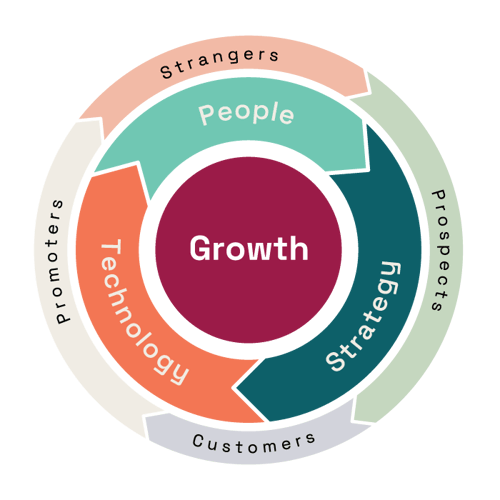
- Evenbound’s Industrial Growth System fixes CRM adoption problems by sequencing the build: Strategy, then People, then Technology.
- You need to configure HubSpot around how your team sells, not a default setup.
What Causes Low CRM Adoption in Industrial Companies?
|
CRM Adoption refers to the degree to which a sales team consistently and accurately uses a CRM as part of their daily workflow, not just whether someone trained them on it or they logged in once. |
Low CRM adoption usually comes down to four root causes:
- Most vendors build the system around HubSpot’s default setup instead of around teams’ unique sales processes.
- Nobody plans for change management.
- The CRM adds admin work instead of removing it.
- Nobody owns the process after go-live.
Industrial sales teams run on relationships, technical quoting, and long cycles that don’t fit a generic pipeline. When a vendor ships a CRM with five stock deal stages and a rep’s actual process has nine, the rep stops updating it. Not because they’re lazy, but because the tool didn’t match reality.
Our 2026 State of Digital Transformation in the Construction Industry report, conducted with HubSpot and Datalily, found 50% of construction firms spend more than 10 hours a week on manual data entry — the same admin work a well-configured CRM is supposed to eliminate.
A CRM that should cut that admin load instead adds to it when configuration misses the mark, and reps can tell the difference within days.
See how we approach CRM implementations at Evenbound →
Why “Train the Team More” Doesn’t Fix a Broken CRM
More training doesn’t fix low adoption because the issue isn’t knowledge. It’s that the system doesn’t reflect how the work actually happens day to day. You can teach a rep every field in HubSpot, and they’ll still skip half of them if filling them out doesn’t help them close deals faster.
We’ve sat in enough post-launch reviews to know the pattern. Leadership blames the reps, reps blame the system. Both are half right and both are missing the true cause, which is that nobody built the CRM around the selling motion in the first place.
So, here’s a rhetorical question worth asking before your next training push: If your best rep, the one who closes the most business, isn’t using the CRM either, is that a training gap or a system gap?
The Order of Operations for a Strong CRM Implementation
The right order of operations for a CRM implementation is Strategy, People, Technology. In that sequence.
This is the backbone of Evenbound’s Industrial Growth System (IGS). We built it after watching CRM projects fail for the same reason over and over, due to teams prioritizing technology before they define how they operate and why.
Default CRM Implementation vs. Industrial Growth System Implementation |
||
|
Stage |
Default Build Sequence |
IGS Implementation |
|
1 |
Buy HubSpot, start configuring pipelines |
Define strategy, growth goals, and decision owners |
|
2 |
Migrate existing data as-is |
Map how the team sells, follows up, and hands off work |
|
3 |
Train the team on the “finished” system |
Document the process the CRM needs to support |
|
4 |
Hope adoption follows |
Configure HubSpot around the documented process, then train and assign ownership |
See how an Industrial Growth System CRM implementation plays out. We used it to help an automotive group standardize B2B sales across 140 franchises in HubSpot CRM. View the case study →
How Should You Set Up HubSpot So Sales Reps Use It?
You should configure HubSpot around your team’s selling behavior, with custom pipeline stages that match actual deal progression, activity tracking built around what reps already do, deal stage automation that removes manual steps instead of adding them, and reporting dashboards leadership can trust because they reflect reality.
Pipeline customization is where most generic implementations fall apart first. If your sales motion includes a technical review, an engineering sign-off, and a multi-stakeholder approval before a quote goes out, a stock “qualified, proposal, closed” pipeline isn’t going to hold that information.
Activity tracking only works when it captures what reps are already doing, not when it asks them to do extra work to prove they did something. Deal stage automation should move records forward based on triggers, like a signed quote or a completed site visit, instead of requiring a rep to manually update a dropdown every time something changes.
A sales rep will use HubSpot when it reflects how they actually work. That’s when the CRM stops feeling like extra admin work and starts functioning as the place reps naturally go to manage their day.
Talk to us about configuring HubSpot around your team’s sales process →
Who Owns CRM Adoption After Go-Live?
You have to assign ownership for CRM adoption at every stage of the IGS sequence, not hand it off once and forget it after launch.
- Someone owns the strategy and growth goals.
- Someone owns the people and process documentation
- Someone owns the HubSpot configuration.
- Someone owns adoption after go-live.
That last part is critical. Most adoptions die after go-live. A CRM needs a named owner who checks activity logging, pipeline accuracy, and rep feedback for months after launch, not just during rollout week.
Connect How Buyers Move, Teams Follow Up, and Customer Work Gets Managed
Low CRM adoption isn’t a people problem you can train your way out of. It’s a sequencing problem, and you fix it by defining strategy and people before the HubSpot build begins, then configuring the system around how your team sells.
Companies that get the order right end up with a CRM reps use because it makes their job easier, not harder.
We can help make CRM adoption happen for you. Reach out online to get started.