If you're a HubSpot user, you may have noticed AEO pop up in your portal recently. For industrial and manufacturing companies especially, where buyers research for months before ever filling out a form, showing up in an AI-generated answer could now matter more than showing up on page one of Google. If you're not sure what AEO is, what it does, or whether it's worth your attention, this post is for you.
Here’s the short version of why HubSpot AEO matters: organic search traffic for HubSpot customers is down 27% year-over-year. The buyers who used to find you by scrolling search results are now asking ChatGPT, Gemini, Perplexity, and Claude instead. If your brand isn’t showing up in those answers, you’re out of the conversation before it starts. HubSpot AEO is built to tell you where you stand and what to do about it.
I’ve been setting up and running HubSpot AEO for clients at Evenbound, and I recently completed HubSpot Academy’s AEO Certification. What follows is based on real experience during my time with the new tool.
Key Takeaways
- HubSpot AEO and the HubSpot AEO Grader are two separate tools. AEO is a paid ongoing monitoring tool, the other is a free one-time snapshot.
- HubSpot AEO is included in Marketing Hub Professional and Enterprise, or available as a $50/month standalone add-on.
- HubSpot AEO generates prompt suggestions using your CRM data.
- Measuring AEO requires a different set of metrics. Traditional metrics like organic traffic and click-through rate don’t capture AI visibility.
- HubSpot AEO is only as useful as the data and content strategy behind it. Clean CRM data and sound content architecture come first.
What Is HubSpot AEO?
HubSpot AEO is a paid monitoring and optimization tool that tracks how your brand appears in AI-generated answers across ChatGPT, Gemini, and Perplexity (Claude coming soon) on an ongoing basis. It is currently in beta.
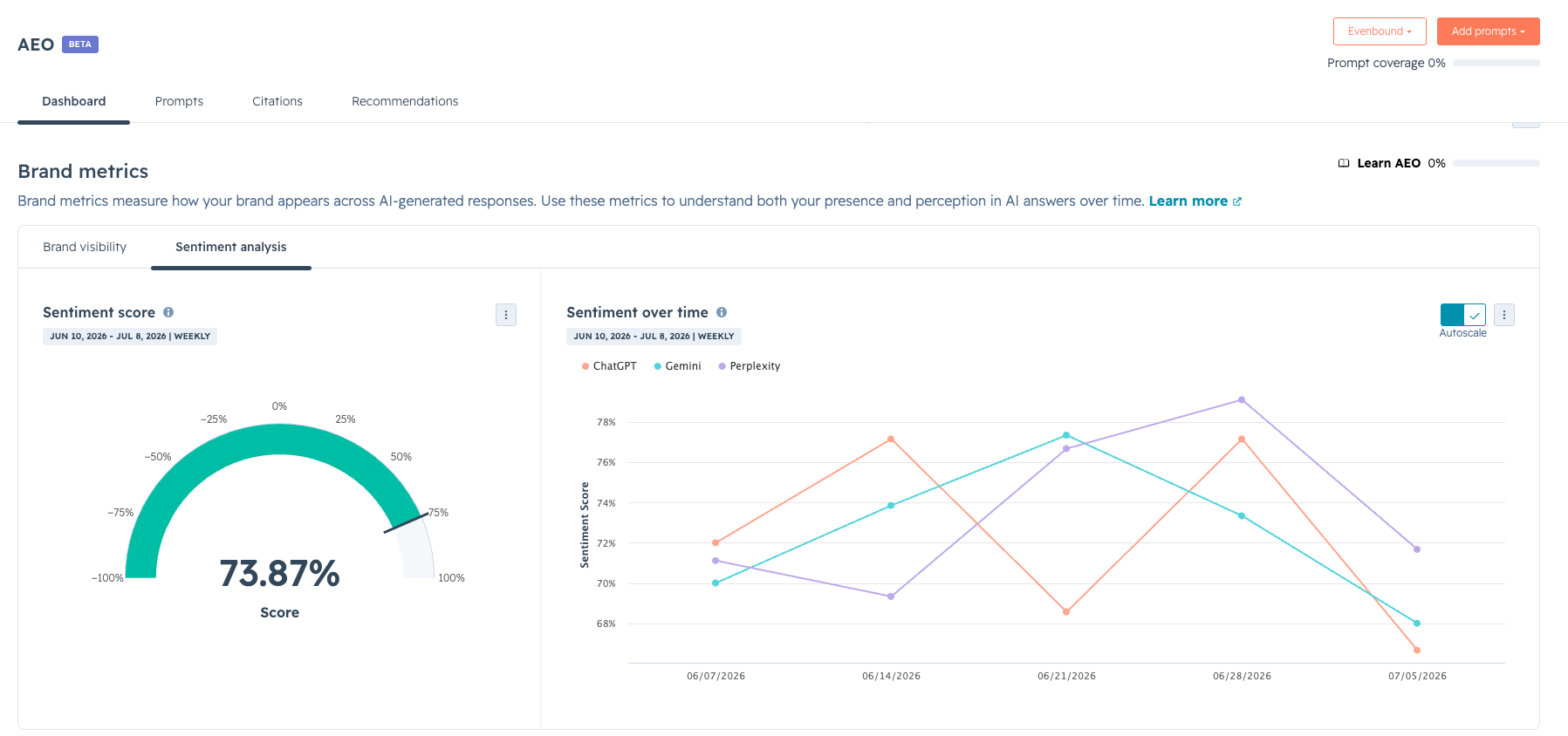
The tool gives you a brand visibility score, competitive share of voice data, citation analysis, and prioritized recommendations for content all inside your HubSpot portal.
|
Definition: Answer Engine Optimization (AEO)
The practice of improving how often and how accurately your brand appears in AI-generated answers on platforms like ChatGPT, Gemini, Perplexity, and Claude. AEO builds on SEO fundamentals, but measures success through brand mentions and citations, not clicks and keyword rankings. |
HubSpot AEO is included in Marketing Hub Professional and Enterprise subscriptions. It is also available as a standalone add-on at $50/month.
What Is the HubSpot AEO Grader? How Is It Different?
The HubSpot AEO Grader is a free, one-time brand check — no HubSpot account required. You enter your company name, location, industry, and product or service, and the tool queries ChatGPT, Gemini, and Perplexity to see how each engine currently characterizes your brand based on its training data. Your results come back as a score out of 100, broken down across five dimensions including sentiment, share of voice, and competitive positioning.
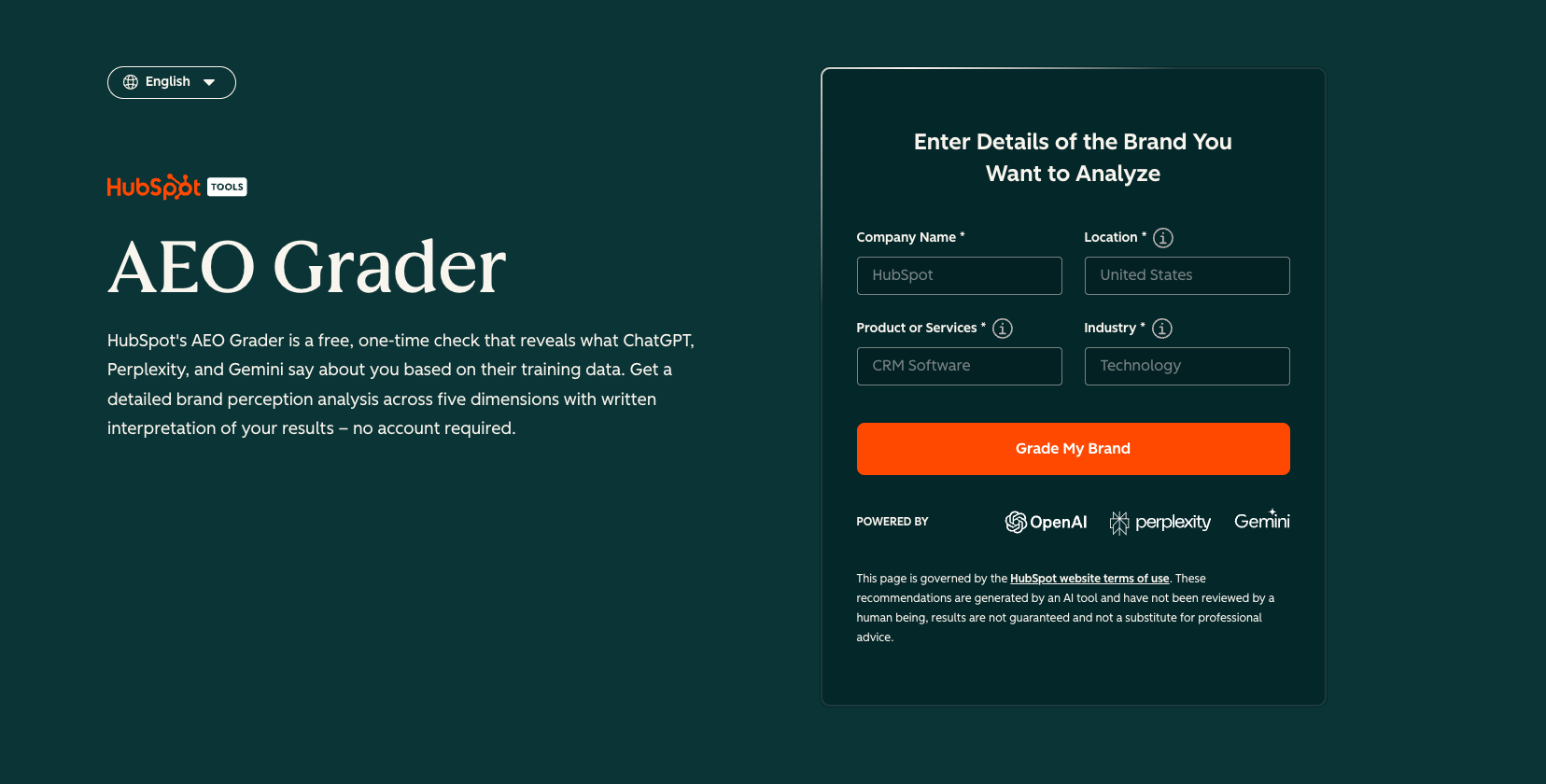
The HubSpot AEO Grader gives you a snapshot. HubSpot AEO gives you an ongoing system.
Here’s the practical difference between the two tools in a table:
|
HubSpot AEO Grader |
HubSpot AEO (Beta) |
|
|
Cost |
Free |
$50/month (or included in Marketing Hub Pro/Enterprise) |
|
HubSpot Account Required? |
No |
Yes |
|
Data Source |
LLM training data at time of query |
Daily live queries across ChatGPT, Gemini, Perplexity |
|
Tracking Frequency |
One-time snapshot |
Ongoing, weekly and daily |
|
Scoring |
Score out of 100 across 5 dimensions |
Brand Visibility Score (0-100%), updated continuously |
|
Competitor Tracking |
Included in snapshot |
Yes, with share of voice over time |
|
Recommendations |
Not included |
Yes, prioritized content actions |
|
CRM Integration |
No |
Yes, prompts and recs based on your CRM data |
|
Best For |
First look at your current AI positioning |
Teams actively managing and improving AI visibility |
The AEO Grader is useful if you want a baseline read on how AI describes your brand today. HubSpot AEO is what you use when you’re ready to move that number.
On-Demand Webinar: AI Is Talking About You. How Do You Shape the Answers? Watch It Now →
What Does HubSpot AEO Measure?
HubSpot AEO measures brand visibility, share of voice, and brand mentions and citations in AI search.
How Does the HubSpot AEO Brand Visibility Score Work?
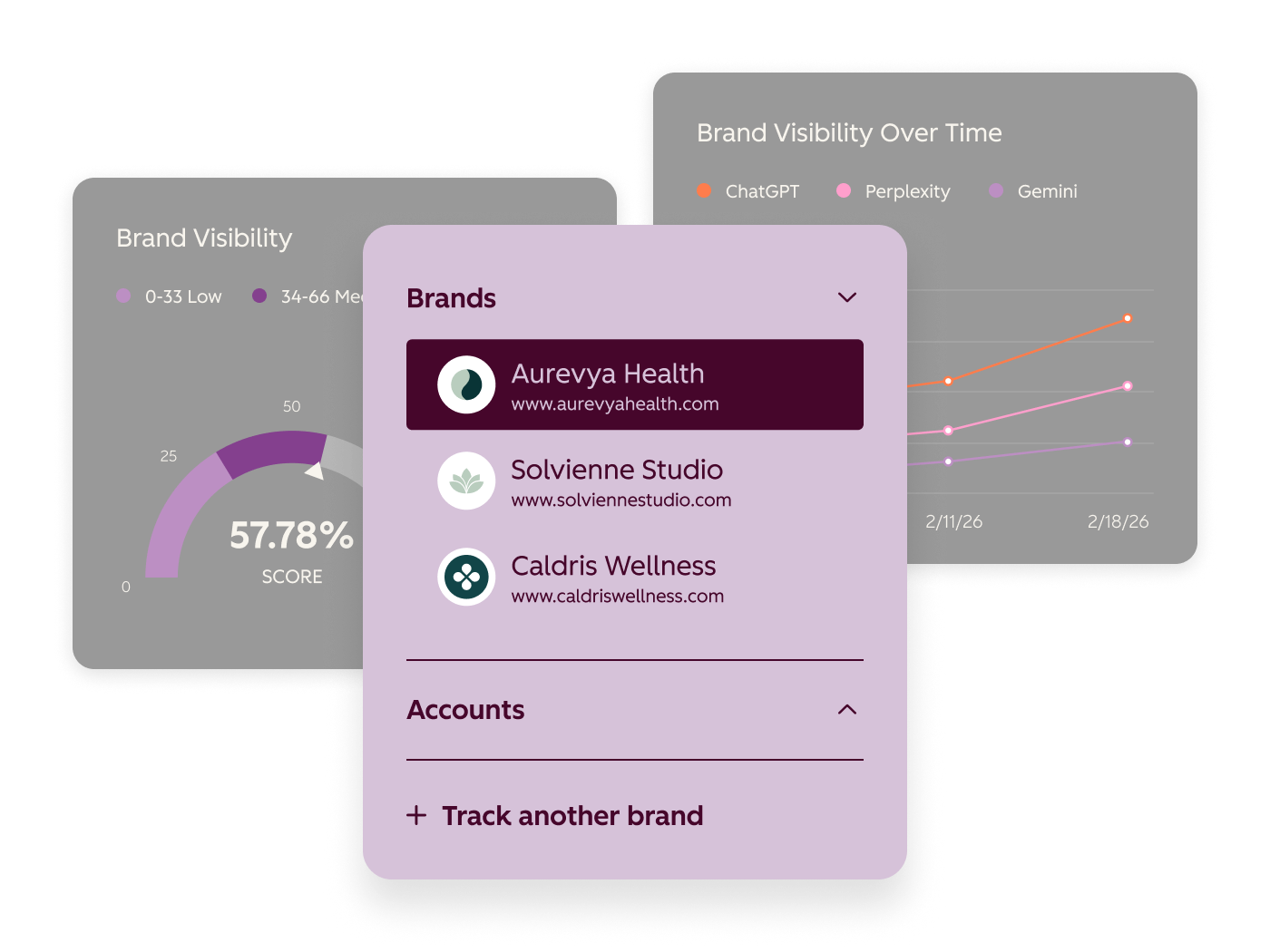
Your Brand Visibility Score is a percentage representing how often your brand appears in AI-generated answers across the prompts HubSpot is tracking for your business. The higher the score, the more often AI includes your brand when buyers ask relevant questions. HubSpot runs those prompts daily across all three engines and aggregates the results into a trend you can track week over week.
According to HubSpot, their 850 beta customers drove 20% more traffic from AI than customers not using the tool. That gap will compound over time.
What Is Share of Voice in AI Search?
Share of voice measures what percentage of AI mentions in your category go to your brand versus your competitors across the same prompts. It’s a competitive signal that tells you whether you’re gaining or losing ground relative to the alternatives your buyers are being shown.
A brand cited heavily but rarely named has strong content but weak authority, while a brand frequently named but rarely cited has the opposite problem. The two metrics tell different stories. HubSpot AEO tracks both, so you can see which issue you need to solve for.
|
AI Mentions vs. AI Citations
AI mentions are how often your brand name appears in an AI-generated answer, with or without a link back to your site. AI citations are when AI attributes specific information to your content and links to it as a source. Mentions build brand awareness in AI answers. Citations build authority. You want both. |
How Does AI Citation Analysis Help with AEO?
Citation analysis breaks down which domains and content types (owned content, competitor pages, social platforms, third-party publications, user-generated content) are driving AI mentions for your brand and your competitors. It shows you whether AI is drawing its understanding of your business from your website, trade publications, LinkedIn, or somewhere else entirely.
That matters because it tells you where to invest your content effort, not just what topic to cover next.
How HubSpot AEO Is Different from Other AEO Tools: CRM Integration
Most AEO tools, even good ones, require you to manually define the prompts they track. You describe your industry, product or service category, and competitors, and then the tool builds a general prompt list from that input.
HubSpot AEO works differently. Because it lives inside HubSpot, it uses your CRM data (customer segments, deal history, lifecycle stages, industry signals, etc.) to suggest prompts that reflect what your buyers are asking. It’s not templated.
HubSpot’s own data shows that AI-referred leads convert at 3x the rate of traditional search leads. Getting the right prompts tracked is what makes that conversion rate useful to your pipeline.
Prompt strategy isn’t a settings problem. It’s a positioning problem. See how we approach it →
How to Implement HubSpot AEO Recommendations
The Recommendations tab inside HubSpot AEO surfaces prioritized actions based on your visibility gaps. This might include:
- A new blog post to write
- An existing page to restructure
- A LinkedIn presence to build out
- An FAQ schema to add
For companies already working in HubSpot, those recommendations connect directly to the content tools and workflows already in place, including HubSpot AI tools for content generation.
If you’re not sure what to prioritize, I recommend starting with your highest-traffic existing page and adding question-based headers with direct 40-60 words answers at the start of each section. That structure makes it easier for AI engines to extract and cite your content. It’s pretty quick to do and it will go a long way, especially on a page that’s already performing in the traditional sense.
From there, continue to work through the recommendations within the HubSpot AEO tool and track your Brand Visibility Score week over week as you act upon them.
How Do You Measure AEO Performance? Key Metrics to Track
HubSpot AEO handles the AI visibility layer, but a complete picture requires pulling from multiple sources. You can organize these signals into three tiers based on how directly they connect to real user behavior. The closer a metric is to an observable action on your site, the more confidence you should have in using it to make decisions.
Tier 1: Directly Observable AEO Metrics
These are the AEO metrics you can track in tools you already have. When you’re reporting AEO performance to anyone who controls the budget, start here.
-
AI referral traffic in Google Analytics (GA4): In GA4’s traffic acquisition report, sessions from domains like chat.openai.com or perplexity.ai show up as referral traffic. This is direct, attributable evidence that people are encountering your brand in AI-generated answers and clicking through. Volume will likely be small compared to organic search, but quality tends to be high because these visitors arrive with more context than a typical search click.
-
Branded search volume in Google Search Console: When AI mentions your brand in an answer, many buyers don’t click through immediately. They search for you by name later. A rising trend in branded queries in Search Console is one of the most reliable downstream signals that AI visibility is generating awareness.
-
Conversion data for AI-referred visitors: Knowing AI traffic is arriving isn’t enough. In HubSpot, you can build reports that track how AI-referred sessions compare to organic search on engagement, form fills, and pipeline contribution. This is what connects AEO effort to business outcomes, and it’s the layer that matters more to leadership.
Tier 2: AEO Metrics That Require Interpretation
These metrics capture something about your presence in AI-generated answers, but they require more manual effort and context to read correctly. Use them to spot patterns and inform strategy, not to make decisions based on any single data point.
- Citation and mention tracking: You can monitor this through HubSpot AEO’s citations tab, or manually by running prompt tests in ChatGPT, Perplexity, Gemini, and Claude to record whether your brand appears, how it’s described, and whether it’s linked. Because AI systems produce different results every time they’re asked the same question, don’t react to a single check. Instead, look for patterns across multiple sessions over time.
- AI Overview appearances in Google Search Console: Google doesn’t currently provide a separate report for AI Overview inclusion, but you can infer it. Pages gaining impressions without a proportional increase in clicks are likely being surfaced in AI Overviews, where users read a synthesized answer without clicking through. Under a traditional SEO lens, that looks like a problem, but under an AEO lens, it may mean the content is doing exactly what you want it to do.
Tier 3: AEO Directional Indicators
Visibility scores and share-of-voice percentages (including what HubSpot AEO provides) falls into this tier. They’re useful for watching broad trends over weeks and months, but they’re unreliable as precise, point-in-time measurements.
A 2026 SparkToro study had 600 volunteers run the same prompts through ChatGPT, Claude, and Google AI thousands of times. The result found less than a one-in-one-hundred chance of getting the same brand list back in any two responses. AI systems are inconsistent — not because anything changed about your content, but because that’s just how they work.
That’s why HubSpot AEO runs prompts daily and aggregates trends over time rather than giving you a single static score. Read your Brand Visibility Score the same way: as a directional trend to watch, not a hard number to present to leadership in isolation.
Put simple tracking in place so AEO becomes something you manage intentionally. Download the AEO Performance Workbook →
The Tool Shows You the Gap. Strategy Is What Fills It.
HubSpot AEO is a useful tool, but it’s still a tool.
The visibility score tells you where you’re missing. The citation analysis tells you what’s being cited instead of you. The recommendations tell you what content to create or update. What the tools cannot do is decide whether that content is positioned correctly, written with the authority your buyers expect, or structured around the questions your best prospects are asking.
The companies that will win in AI search aren’t the ones who plug in a tool and generate content recommendations. They’re the ones who get the strategy right first.
The order of operations extends to your CRM data as well. HubSpot AEO generates its prompt suggestions based on what it already knows about your business and buyers. If that data is incomplete, misconfigured, or doesn’t reflect how your buyers actually move through a sale, the tool is building recommendations on a flawed foundation. Clean data and sound CRM architecture are prerequisites for getting AEO inputs worth acting on.
AEO doesn’t replace your content strategy. It exposes whether you have one. Start a conversation →