What Is the Industrial Growth System?
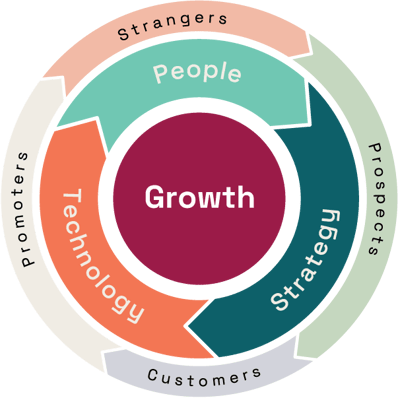
The Industrial Growth System (IGS) is Evenbound’s proprietary methodology for aligning strategy, people, and technology into a single, high-performance growth engine for industrial companies. Instead of treating marketing, sales, and technology as separate entities, IGS sequences them in a specific order (strategy first, people second, technology last), so that every tool serves a defined outcome instead of operating in a silo.
I built it after 15+ years of working alongside industrial companies, from factory floors to distribution hubs, and watching the same problem play out again and again: operationally excellent teams struggled to grow because they approached growth as a series of disconnected tactics instead of a system.
Why Do Industrial Growth Efforts Fail?
Most industrial growth efforts fail because they start in the wrong order: tactics before strategy, and tools before people.
In the industrial mid-market, “standard” marketing doesn’t solve the underlying problem. When sales, service, and operations aren’t aligned, even the best software becomes a hidden cost, often called the silo tax: the duplicated work, lost data, and dropped customers that pile up every day when systems don’t talk to each other.
Here’s what that pattern might look like in real life:
- A company buys a new CRM, but nobody owns the data, so adoption dies within a year (often less)
- Marketing, sales, and service each pick their own tools, so the same customer exists as three or four different records
- Leadership redesigns the website or swaps marketing agencies, expecting a tactical fix to solve a structural problem
Everyone stays busy, but growth stays flat because no one has answered the only question that matters: What are we trying to win, and who are we trying to win it from?
None of this is a strategy. It’s tactics wearing a growth costume.
Want to see where your growth system is breaking down?
What Are the Three Engines of the Industrial Growth System?
The Industrial Growth System runs on three engines: strategy, people, and technology. The sequence is non-negotiable.
|
Engine |
What It Does |
What Happens If You Skip It |
|
Strategy |
Defines who you’re uniquely qualified to serve, what makes your offer different, and what number moves if you’re winning |
Marketing becomes a generic activity, sales becomes order-taking, and every downstream decision is expensive guessing |
|
People |
Assigns ownership of the system and the data, sets clear rules for use, and puts subject matter experts front and center |
Even great software gets bypassed for spreadsheets within a year (or less) because nobody trusts or owns it |
|
Technology |
Unifies the tools into one architecture that amplifies strategy and empowers people |
You get a more expensive version of the same disconnected mess you started with |
Why Does Strategy Come First?
Strategy comes first because without a clear definition of what winning looks like, nothing else has a center of gravity. “Grow revenue” is a wish, not a strategy.
We start right because how we start is how we finish. This means getting clear on goals, ownership, and outcomes before technology ever enters the conversation.
Why Do People Come Before Technology?
People come before technology because technology does not advance industrial businesses. People do. Real adoption requires someone who owns the system and the data by name, clear rules for how it gets used, and a team that understands why it works the way it does, so they improve it instead of fighting it.
What Is the “Industrial Triad” of Technology?
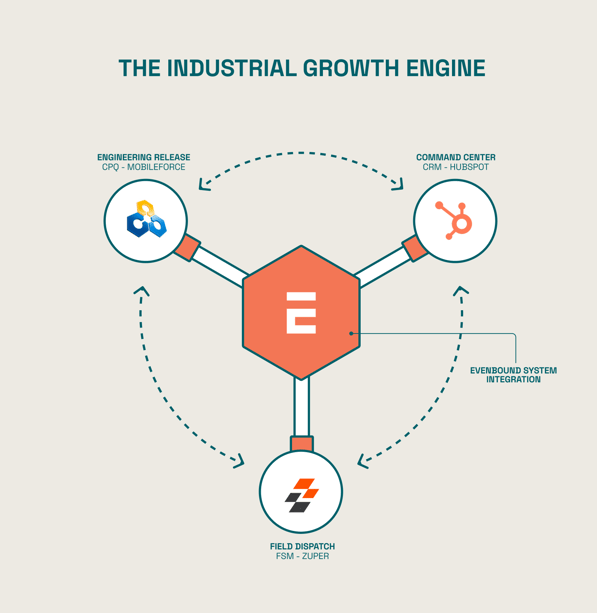
The Industrial Triad is the unified technology architecture we build once strategy and people are in place. It’s made up of three connected systems: your customer relationship management (CRM) tool, your configure-price-quote (CPQ) tool, and your field service management (FSM) tool.
- Your CRM is the Command Center and single source of truth for customer data across marketing, sales, and service
- Your CPQ is the Complex Quoter, eliminating the “Excel Hell” of manual, error-prone quoting
- Your FSM is the Field Commander, connecting field service and technicians back into the same system
Technology is a multiplier. It amplifies strategy and empowers people. It should never replace either one.
Curious how the Industrial Triad fits your existing tech stack? Let's Talk!
I Tested This on My Own Business Before Selling It
I don’t ask clients to do anything I haven’t already done to my own business first.
My journey didn’t start in a boardroom. It started as an owner-operator, building Evenbound from scratch. Six years ago, we implemented EOS® (the Entrepreneurial Operating System®) and got obsessive about our own systems, processes, and data.
Here’s what that discipline has produced:
- 20%+ annual growth since implementing EOS
- Inc. 5000 list of America’s fastest-growing companies
- 90% growth over three years (per Inc. 5000)
- Hubspot Elite Solutions Partner status
- 3x HubSpot Impact Award winner
We took the hard path with our own business before we ever offered the system to a client. We know the way because we go the way.
That’s the reason I trust this system enough to put my name on it.
Access the Industrial Growth System
I’ve seen too many industrial leaders get burned by big promises and vague strategies. But growth isn’t magic. It’s engineered. If someone can’t explain exactly how their system works, they probably can’t deliver it consistently.
That’s why I’m making the Industrial Growth System available. It’s a full knowledge base with playbooks, technology, a scorecard, and a flywheel.
Because I believe industrial companies deserve a better way.
I’m glad you’re here. Let’s get to work.