Most B2B industrial companies don’t fail with HubSpot because they chose the wrong CRM.
They fail because they confuse HubSpot onboarding with HubSpot implementation — and assume the two deliver the same outcome.
They often use the terms "HubSpot onboarding" and "HubSpot implementation" interchangeably. This is a costly misconception.
While onboarding focuses on the "how-to" of the software, implementation focuses on the "why" and "how" of your unique business.
For organizations with long sales cycles, technical buying committees, dealer or distributor networks, and complex handoffs between marketing, sales, and service, that assumption is expensive. A basic setup might get HubSpot live, but it won’t reflect how your business actually operates.
This is where the distinction between HubSpot implementation vs. onboarding really matters.
Onboarding focuses on learning the tool: logging in, connecting inboxes, importing contacts, and understanding where things live. Implementation, on the other hand, is about designing HubSpot around your revenue engine — your processes, your data, and your go-to-market motion.
For B2B industrial teams, mistaking a basic onboarding for a true implementation doesn’t just slow adoption. It creates misaligned pipelines, unreliable reporting, broken automations, and a CRM your sales team quietly avoids.
In this article, we’ll break down:
- The real difference between HubSpot onboarding vs. implementation
- Why industrial companies almost always need more than standard onboarding
- The operational and revenue risks of getting this wrong
- How to tell which path your organization actually needs
What Is the Difference Between HubSpot Onboarding and Implementation?
HubSpot onboarding teaches teams how to use the software.
HubSpot implementation designs HubSpot around how your business actually sells, markets, and operates.
For B2B industrial companies with long sales cycles and complex workflows, onboarding alone is rarely enough.
To understand why many industrial teams struggle with HubSpot adoption, it’s important to look at the structural differences between onboarding and implementation — not just the terminology.
What is HubSpot Onboarding?
Think of onboarding as the "driver’s education" of the CRM world.
It’s a structured, often standardized process designed to ensure you know where the buttons are and how to perform basic tasks. During onboarding, a specialist (either from HubSpot or a partner) will help you:
- Connect your domain and email inboxes
- Import contact data from a clean CSV
- Navigate core features and settings
HubSpot onboarding is a technical handoff. The goal is to get HubSpot live and usable, so you can begin operating inside the platform with a baseline understanding of its tools.
Who Needs HubSpot Implementation Instead of Onboarding?
HubSpot implementation is typically required if your organization has:
- Long or multi-stage sales cycles
- Technical or engineering-driven buying committees
- Distributor, dealer, or rep networks
- ERP systems that act as systems of record
- Post-sale service, maintenance, or warranty tracking
If any of these apply, standard onboarding will leave critical gaps in data, reporting, and adoption.
What is HubSpot Implementation?
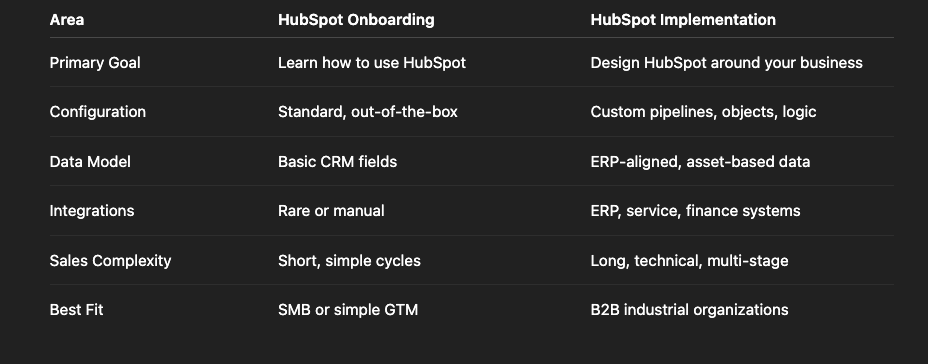
Implementation is the "custom engineering" of your digital ecosystem.
It is a consultative, deep-dive process that aligns the platform with your specific B2B industrial workflows. Implementation doesn't just ask, "How do we create a deal?" It asks, "How do we mirror your 18-month capital equipment sales cycle, including the technical engineering review, the distributor markup, and the final procurement sign-off?"
A true HubSpot implementation for industrial companies typically includes:
- ERP Integration: Syncing your CRM with legacy systems like SAP, Oracle, or Global Shop Solutions.
- Custom Data Modeling: Moving beyond "First Name" and "Last Name" to track "Installed Base," "Machine Serial Numbers," or "Maintenance Cycles."
- RevOps Alignment: Ensuring that the hand-off from a technical lead to a regional sales manager is automated and documented.
The High Cost of a Poor Implementation Experience
In the industrial sector, a poorly executed HubSpot rollout doesn’t just create a messy contact database. It introduces technical debt, reporting gaps, and process friction that can take years to undo.
When a complex industrial organization relies on basic onboarding instead of a full HubSpot implementation, three issues show up consistently:
1. The "Ghost Town" Portal (Low Adoption)
Industrial sales veterans are notoriously protective of their processes. If they log into HubSpot and see a generic "Sales Pipeline" that doesn't reflect how they quote custom machinery, they won't use it.
Poor implementation fails to involve the end-users in the design phase. When the system feels like "extra work" rather than a "workhorse," your team will revert to spreadsheets and sticky notes, leaving your expensive CRM empty.
2. Data Silos and "Dirty" Reporting
If your HubSpot instance isn't properly integrated with your production or inventory data, you’re only seeing half the picture. We often see industrial firms with "onboarded" portals where Marketing is celebrating lead volume while Sales is frustrated because those leads are for replacement parts—not the high-margin new equipment the business is targeting.
Without a strategic implementation that defines Lead Scoring based on your Ideal Customer Profile (ICP), your reporting will be a "garbage in, garbage out" scenario.
3. Broken Automations and Customer Friction
Industrial buyers expect technical expertise and timely follow-ups. A poor implementation might result in "brittle" workflows—automations that trigger the wrong email to a long-term distributor or fail to notify a technician when a warranty is about to expire. These small digital fractures erode the trust you’ve spent decades building in the physical world.
Takeaways for the Strategic Industrial Leader
HubSpot Implementation Is a Business Transformation — Not a Software Setup
Successful HubSpot implementation requires you to look "under the hood" of your current processes. You must be willing to document—and sometimes challenge—the way your teams communicate.
For industrial companies, this means mapping the buyer's journey from the first time an engineer downloads a CAD file to the moment the equipment is decommissioned ten years later.
Data Architecture Must Come Before Automation
You cannot automate a mess.
A strategic implementation prioritizes data structure, hygiene, and governance before any workflows or nurture sequences are built. This starts with defining a single source of truth and clearly mapping how data flows:
- From your website into HubSpot
- Across lifecycle stages and pipelines
- Into downstream systems like ERP, accounting, or service platforms
Without this foundation, automation amplifies inconsistencies instead of eliminating them.
The Internal “Champion” Role Is Non-Negotiable
You need a dedicated internal "HubSpot Champion" who understands both the technical and operational sides of your plant or sales office.
This person understands both the technical capabilities of the platform and the real-world realities of your operation. They serve as the bridge between your implementation partner and internal teams, helping:
- Translate business needs into system requirements
- Drive adoption and accountability
- Ensure HubSpot evolves as product lines, markets, and processes change
Without a clear owner, even well-built systems stall over time.
Scalability Requires Custom Objects and Advanced Logic
Standard onboarding rarely taps into HubSpot’s full architectural potential.
For B2B industrial organizations, a “product” is often a long-lived asset — with serial numbers, service histories, locations, and contract terms. A true implementation leverages Custom Objects and advanced logic to track these relationships accurately.
This foundation enables:
- Asset-based reporting
- Proactive service and maintenance outreach
- Targeted upsell and lifecycle campaigns
Capabilities that generic, out-of-the-box setups simply can’t support.
Why This Distinction Matters for Industrial Teams
At Evenbound, we specialize in B2B industrial and manufacturing organizations because we know your business doesn’t operate in a one-size-fits-all model.
We’ve seen many companies invest in HubSpot expecting it to drive growth — only to end up with a platform that technically works, but doesn’t support how their teams actually sell, quote, service, or forecast. In nearly every case, the issue isn’t HubSpot itself. It’s that the organization received onboarding when what they really needed was implementation.
For our clients, the difference between onboarding and implementation is the difference between:
- A CRM that exists as a line-item expense
- And a system that actively supports revenue, visibility, and scale
If your CRM doesn’t make sales execution easier or marketing more precise, it hasn’t been implemented — it’s simply been installed.
Want a CRM That Actually Supports Your Industrial Sales Motion?
If your team feels like they’re fighting their CRM instead of relying on it, that’s a signal — not a failure.
A properly implemented HubSpot portal should reflect your real sales cycles, technical workflows, and operational handoffs. It should reduce friction, not add it.
If you’re ready to move beyond basic setup and build a system designed for long-term growth, we’re here to help.