They might ask ChatGPT:
How do I know what size compressed air system my facility needs?
Or:
What type of cleanroom do I need for medical device manufacturing?
Or:
What's the best way to reduce slag carryover during steelmaking?
That shift matters.
Forrester reports that 94% of business buyers use AI during the buying process, primarily to gather information about vendors and products.
Your buyers are still searching. They're just doing it differently.
As a Content Strategist at Evenbound, a big part of my job is figuring out how to turn what industrial companies know into content their buyers can find and use. Increasingly, that means thinking beyond traditional SEO.
That's where answer engine optimization, or AEO, comes in.
The good news? You don't need to throw out your SEO strategy or completely relearn how to write content for AI search. You need to make good content easier for people and AI engines to understand.
Here's how.
Quick Answer: How Do You Write Content for AI Search?
Writing content for AI search starts with the questions your buyers are asking. Answer those questions directly, organize the information so it's easy to understand, and add original expertise that makes your page more useful than the dozens of generic pages covering the same subject.
A strong AEO approach should:
- Build on SEO, not replace it.
- Target real buyer questions, not just keywords.
- Give the direct answer before adding context.
- Use descriptive headings, lists, tables, definitions, and FAQs where helpful.
- Include original insights from your engineers, technicians, salespeople, project managers, and other subject matter experts.
- Stay useful to the human buyer first.
Why Isn't Ranking on Google Enough Anymore?
Ranking on Google still matters. But buyers now have more ways to research products, services, vendors, and technical problems.
Forrester found that 87% of B2B buyers consider generative AI conversational search a meaningful interaction during their buying process. Buyers are increasingly interacting with synthesized answers rather than visiting individual websites one by one.
That changes the search itself.
Traditional search might look like:
industrial compressed air system
AI search might look like:
How do I know what size compressed air system my manufacturing facility needs?
The second query contains more context. It tells us more about what the buyer is trying to accomplish. And instead of returning ten blue links, an AI engine may build an answer using information gathered from multiple sources.
Your new goal isn't only to rank. It's also to publish information that’s clear, useful, and authoritative enough to help inform that answer.
That doesn't make SEO obsolete. Traditional organic visibility can still introduce buyers to your company and supports the broader discoverability of your website. Think of AEO as another layer of your search strategy, not a replacement for the foundation underneath it.
What Is AEO, and How Is It Different From SEO?
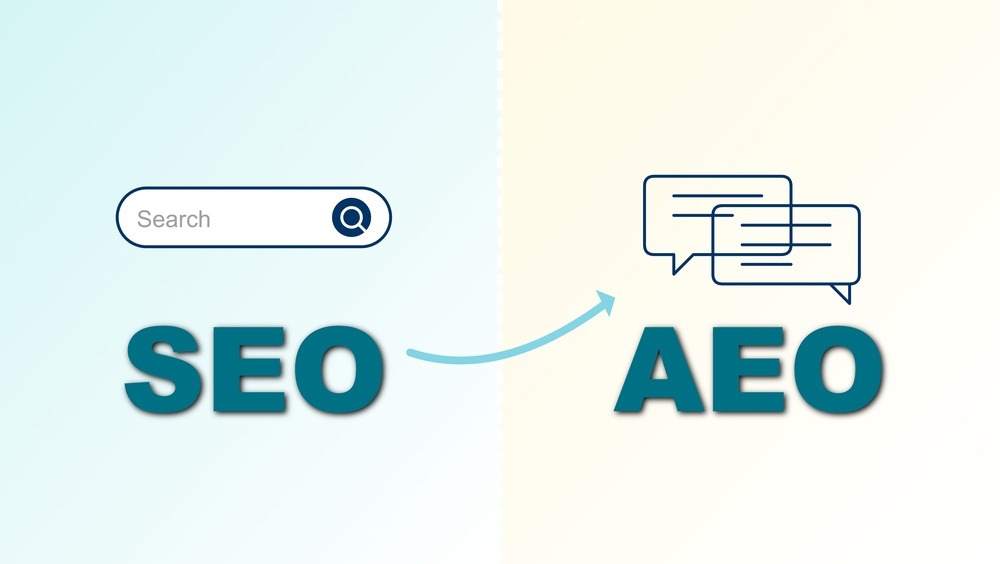
Answer engine optimization (AEO) is the process of creating and structuring content so AI-powered search and answer engines can understand its meaning, identify relevant answers, and potentially reference it when responding to a user's question.
SEO and AEO overlap, but they're not exactly the same.
SEO vs. AEO |
|
|---|---|
|
SEO: |
AEO: |
|
Helps search engines discover and rank content |
Helps answer engines understand and extract information |
|
Often starts with keywords and search intent |
Often starts with specific buyer questions |
|
Optimizes the overall page for search |
Makes individual answers within the page clear and useful |
|
Targets traditional search visibility |
Targets visibility within AI-generated answers |
|
Still requires useful, authoritative content |
Builds on those same fundamentals |
You don't need to pick one.
Strong AEO content should still have a clear keyword strategy, logical site architecture, internal links, crawlable pages, credible sources, and all the other fundamentals that help search engines understand your site.
And there's another important point here: AI is an accelerator, not a strategist.
You can add FAQs, question-based headings, tables, and perfectly formatted answer blocks to a weak article. It's still a weak article.
Structure helps AI understand what you're saying. Expertise gives it something worth understanding.
Before You Write: Find the Questions Your Buyers Are Asking
Good AEO starts before you open a blank document.
Instead of starting with:
What keyword should we rank for?
Start with:
What does our buyer need answered?
For industrial marketers, that distinction is important.
Your audience may be searching for highly technical information about equipment specifications, applications, compliance requirements, installation, maintenance, ROI, troubleshooting, or product comparisons.
Those questions are often sitting right inside your company.
Where Can You Find Real Buyer Questions?
Look at:
- Sales call transcripts
- Discovery calls
- RFPs and RFQs
- Customer emails
- Support tickets
- Search Console queries
- SEO and AEO research tools
- Google's People Also Ask results
- Questions repeatedly answered by salespeople
- Questions your engineers and technicians hear in the field
- Questions buyers ask ChatGPT, Claude, Perplexity, and other AI tools
One of my favorite sources is simply talking to the people closest to the customer. If your sales engineer has answered the same question 20 times this year, there's a pretty good chance somebody should answer it on your website.
Prioritize Questions With Buying Intent
Don't assume the question with the largest monthly search volume is automatically the best content opportunity.
For an industrial equipment company, this question:
How do I know what size compressed air system my facility needs?
may have more business value than a broad topic like:
What is compressed air?
The first person has a problem to solve. They may be comparing equipment, estimating costs, planning a facility upgrade, or preparing to talk to suppliers. That's the kind of question I pay attention to as a content strategist.
Then I decide what the answer deserves. If it's substantial enough to stand on its own and there's clear search opportunity, it may become a blog. If it's an important consideration within a larger topic, it may become an H2. If it needs a concise answer but doesn't warrant 1,000 words, it may belong in an FAQ.
AEO isn't about creating a new page for every possible question. It's about building a content architecture where buyers can find the right answer in the right place.

4 AEO Writing Tips You Can Start Using Today
Once you know the question your buyer is asking, your next job is making the answer unmistakably clear.
These are four of the tactics I use when creating new content and refreshing existing SEO content for AI search.
1. Lead With the Answer
Give the reader the core answer in the first two or three sentences. Then explain it.
You don't need 150 words of scene-setting before getting to the point.
Consider a manufacturer answering:
“How do I know what size compressed air system my facility needs?”
Before:
Compressed air plays an important role in manufacturing facilities across a wide range of industries. From powering pneumatic tools to supporting production equipment, compressed air systems are a critical part of many manufacturing processes. That's why choosing the right system is an important decision.
We still haven't answered the question.
After:
The right compressed air system size depends on your facility's total airflow demand, required operating pressure, peak usage, duty cycle, and expected future demand. Start by calculating the CFM requirements of the equipment that will run simultaneously, then account for pressure drops, leaks, and additional capacity for future growth.
Now I know the answer.
The rest of the article can explain how to calculate CFM, evaluate pressure requirements, account for peak demand, and compare equipment.
This isn't about making everything shorter. It's about putting information in the right order:
Answer → Explain → Support
2. Write Headings and FAQs Like Real Buyer Questions
Your headings should tell readers what they're about to learn.
Compare:
“Integration Considerations”
with:
“What Should Manufacturers Consider Before Integrating HubSpot With an ERP?”
The second heading gives the section context before you've read a word beneath it.
Question-based headings can also closely mirror the conversational way buyers interact with AI search tools.
But don't overdo it. Not every heading needs to be a question. If a statement is clearer, use the statement.
The goal isn't to trick an answer engine with punctuation. It's to make the information hierarchy obvious.
Don't Save FAQs Just for Blog Posts
FAQs can also be useful on:
- Product pages
- Service pages
- Solution pages
- Industry pages
- Comparison pages
- Case studies
A product page, for example, might answer questions about compatibility, operating conditions, sizing, lead times, installation, maintenance, or certifications. Those are useful questions whether the visitor came from Google, ChatGPT, a distributor, or a sales email.
3. Make Complex Information Easy to Extract
Match the format to the information.
One of the easiest ways to make technical content harder to understand is putting everything into paragraphs.
Use:
- Bullets for criteria, features, benefits, or takeaways.
- Numbered lists for processes and instructions.
- Tables for comparisons.
- Definition blocks for technical terminology.
- Key takeaways for long or complex resources.
Here's a simple framework I use:
How to Structure Content for AEO |
||
|---|---|---|
|
Instead of... |
Try... |
Why: |
|
Long introductory setup |
Direct 2–3 sentence answer |
Makes the main answer immediately clear |
|
Vague subheads |
Descriptive buyer questions |
Signals exactly what the section covers |
|
Steps buried in paragraphs |
Numbered list |
Separates each action |
|
Multiple options explained in prose |
Comparison table |
Makes differences easier to scan |
|
Generic industry commentary |
SME examples and experience |
Adds original information |
|
Long article with no recap |
Key takeaways |
Reinforces the most important answers |
But there's an important caveat: Don't add a table because you think ChatGPT likes tables.
Use a table because comparing five equipment options across six criteria in paragraph form would be miserable to read.
The buyer experience comes first.
4. Give AI Something It Can't Find Everywhere Else
Formatting makes information easier to understand.
Original expertise makes the information worth citing.
This is where industrial companies have a major opportunity. You probably have years, sometimes decades, of knowledge sitting inside the heads of your:
- Engineers
- Sales engineers
- Service technicians
- Project managers
- Operations leaders
- Product specialists
- Experienced salespeople
Get that knowledge onto the website.
Interview Your Experts
A weak SME interview question is:
What should we say about this topic?
I like questions that push a little further:
- What do customers consistently misunderstand about this?
- What advice do you give prospects that isn't on our website?
- Where do you see these projects go wrong?
- What would you disagree with in the standard industry advice?
- What happens in the real world that buyers don't expect?
- Can you give me a specific example?
- What happens when someone ignores that advice?
- Do you have numbers, timelines, benchmarks, tradeoffs, or results we can share?
In my experience as a content strategist, the best part of an SME interview is often the answer after the prepared question.
It's the moment you ask, Why?
Or, What happens if they don't?
Or, Can you give me an example?
That's usually where you stop getting the same explanation a competitor could generate from five minutes of online research and start getting something only that expert could tell you.
When possible, attribute that expertise, too. Name the SME and their title. Include their relevant experience. Consider author bios or expert pages that give readers more context about why this person is qualified to speak on the subject.
AI can help you organize and accelerate that process, but it can't replace the person who's spent 20 years troubleshooting equipment on a plant floor.
Don't Optimize for AI at the Expense of Your Buyer
AEO shouldn't make your website sound like it was written for a crawler. Your buyer is still the audience.
That's especially important in industrial B2B, where someone may be evaluating a six-figure piece of equipment, a facility expansion, a new software system, or a partner they'll work with for years.
They need more than a 50-word answer.
They need context. They need technical accuracy. They need to understand trade-offs. They need proof.
Avoid overcorrecting by:
- Turning every heading into a question.
- Adding dozens of loosely related FAQs.
- Converting every paragraph into bullets.
- Repeating the same answer several ways.
- Removing necessary nuance just to make an answer shorter.
- Publishing large volumes of generic AI-generated content.
There's a simple rule I come back to:
If an AEO tactic makes your page less useful or less natural for the person reading it, reconsider it.
What Does AEO-Optimized Industrial Content Look Like?
You don't necessarily need to rebuild an entire page. Often, the information is already there. The problem is how it's presented.
Imagine a manufacturer has an existing article about sizing a compressed air system.
Before AEO Optimization:
The article has:
- A generic 150-word introduction.
- Keyword-focused headings like "Compressed Air Sizing."
- Long paragraphs explaining technical criteria.
- No direct answer to the primary question.
- General information available on dozens of competing sites.
- No input from the company's engineers.
- No comparison tables.
- No FAQ.
After AEO Optimization:
The core subject hasn't changed.
The page now has:
- A two- or three-sentence Quick Answer explaining what determines system size.
- An H2 asking "How Do I Know What Size Compressed Air System My Facility Needs?"
- A short definition of CFM for readers who need it.
- A numbered process for calculating facility demand.
- A table comparing sizing considerations.
- An engineer's explanation of a common sizing mistake they've seen in real facilities.
- A real project example with numbers where available.
- FAQs addressing related buyer questions.
- A concise takeaway summarizing the decision criteria.
That's AEO in practice.
It's not sprinkling "AI-friendly" language throughout a page. It's taking useful expertise and making every important answer easier to find, understand, verify, and reuse.
AEO Isn't a Replacement for SEO. It's the Next Layer.
SEO still matters.
But your buyers aren't researching the way they did five years ago. Your content strategy shouldn't pretend they are.
Start with the questions connected to real buying decisions. Answer them directly. Structure complex information in a way that's easy to understand. Then bring your subject matter experts into the process and publish something original enough to deserve attention.
That's the part no AEO checklist can shortcut. You still have to create something genuinely useful.
If your existing content strategy was built entirely around traditional SEO, Evenbound's AEO Performance Workbook can help you identify where your content is strong, where it's difficult for answer engines to interpret, and where you have opportunities to improve.
Need Help Building an AEO Content Strategy?
Knowing what to change is one thing. Figuring out where to start across an entire website is another.
Evenbound helps industrial and manufacturing companies build content strategies around the questions their buyers are asking, then turn their team's expertise into content that's useful across traditional and AI search.
Whether you're refreshing an existing SEO strategy or building AEO into new content from the start, we can help you identify the right opportunities and put a practical plan behind them.
Ready to make your content easier for buyers and AI search engines to find and use? Reach out to Evenbound.