How B2B Companies Build AI Search Authority That AI Engines Trust
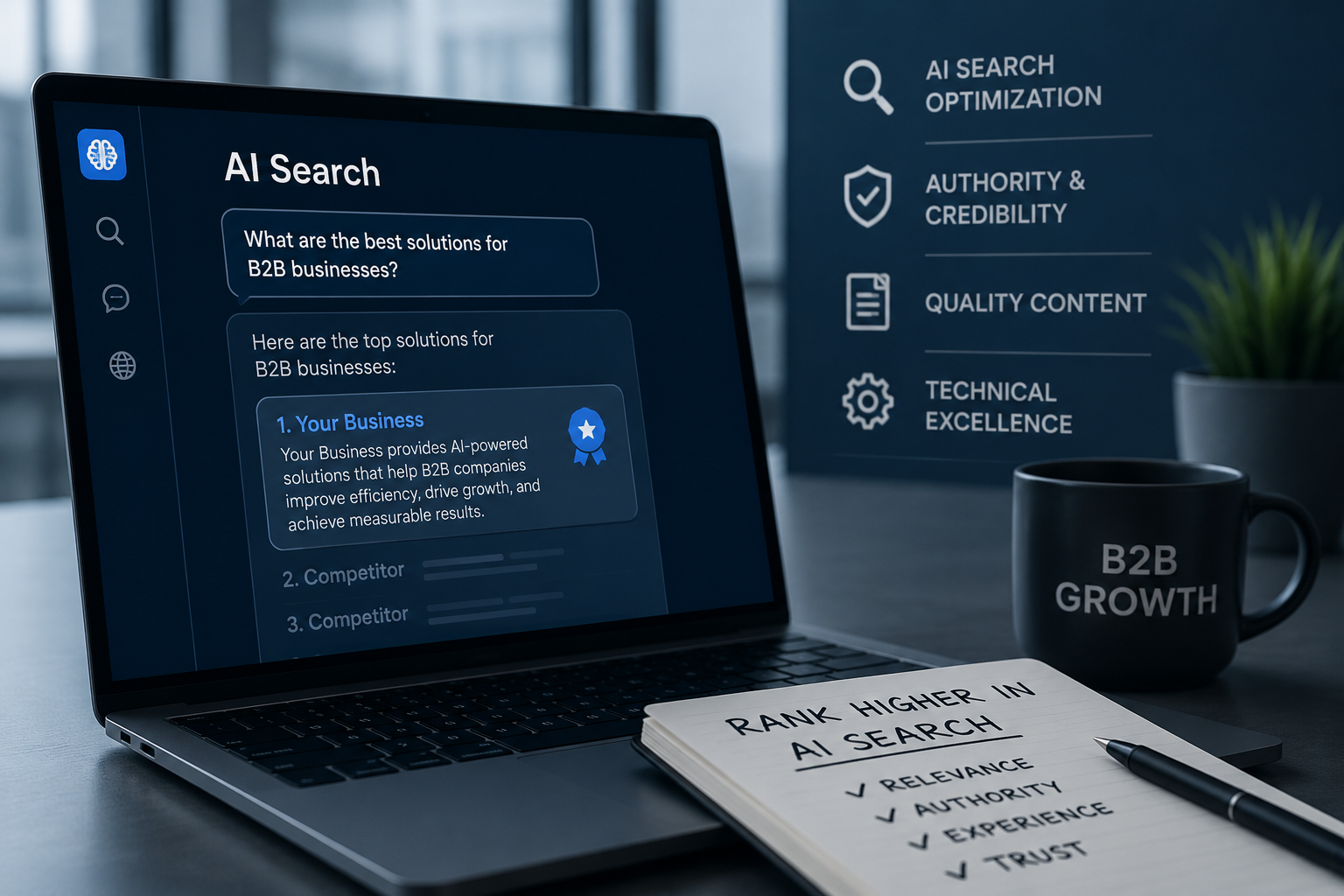
Ranking on page one no longer guarantees visibility. Here's how to become a source AI tools actually cite.
AI search tools don't rank content — they select sources to trust.
When a buyer asks an AI tool which cybersecurity vendor to consider, or which consultancy specializes in supply chain finance, the model doesn't return ten blue links. It synthesizes an answer and pulls from a shortlist of sources it deems credible.
For B2B companies, this shift is significant. Your buyers already have longer cycles and more complex needs than their B2C counterparts.
Add AI-mediated discovery to the mix, and the question changes from "are we findable?" to "are we trusted?" Those are different problems with different solutions.
AI search authority isn't built on one tactic. It's the cumulative signal across your content, your reputation, your proof, and your digital presence — all aligned and pointing in the same direction.
Quick Ways to Build AI Search Authority
Companies that earn visibility in AI-generated search results tend to share the same core authority signals. Here are the key areas B2B companies should focus on:
- Define and consistently reinforce your area of expertise
- Create clear, structured, and extractable content
- Strengthen trust with reviews and external validation
- Use case studies to prove real-world impact
- Maintain consistent positioning across your digital presence
- Improve site structure, internal linking, and schema
- Contribute original insights and industry perspectives
How to Build AI Search Authority That Search Engines Trust
Building authority in AI search requires more than publishing content and ranking for keywords. To become a source AI search engines trust and cite, B2B companies need clear expertise, structured content, external validation, and consistent positioning across their digital presence.
1. Define and Own Your Area of Expertise
|
Key principle:
Authority starts with focus, not volume. AI tools favor sources that are clearly about something — not sources that cover everything. |
The instinct in content marketing is to cast a wide net. Cover more topics, target more keywords, attract more traffic. But breadth is the enemy of authority.
If your blog bounces between HR trends, supply chain logistics, and general business advice, no AI model (and no human reader) will associate your brand with expertise in any of them.
The companies that earn AI citations tend to have a clear point of view: they serve specific industries, they solve specific problems, and every piece of content reinforces that positioning. Pick your lanes and stay in them.
What this looks like in practice
- Dedicated, well-developed service and industry pages — not thin overviews
- Blog content that consistently returns to your core topics
- Subject matter expert input on every piece (not generic, outsourced writing)
- A clear answer to: "What are we the definitive source on?"
2. Create Content That Is Clear, Structured, and Extractable
|
Key principle:
AI tools prioritize content that they can quickly understand and extract from. If your answers are buried in long paragraphs, they're less likely to be surfaced. |
The shift from keyword-heavy to clarity-first content is one of the most important adjustments B2B marketers can make right now.
AI models don't skim — they parse. They extract answers, definitions, comparisons, and data. Content structured for extraction performs significantly better than content optimized solely for keyword density.
Think of an AI-readable structure as writing for two audiences at once: the human who will read your page, and the model that will decide whether to cite it. Both want the same thing — clear answers, fast.
Structural elements that improve AI visibility
- Direct answer blocks: a 1–2 sentence summary immediately under each heading
- Question-based headers that mirror what buyers actually ask
- Definition-style formatting when introducing industry-specific terms
- Comparison tables and structured lists over dense paragraphs
- FAQ sections that target long-tail and conversational queries
- Key takeaway summaries at the end of longer posts
A useful test: can someone extract a complete, accurate answer to a specific question from your page without reading the whole thing? If not, restructure until they can.
3. Strengthen Trust With Reviews and External Validation
|
Key principle:
AI models are trained on a broad web corpus. A brand mentioned only on its own site is inherently less credible than one referenced across multiple third-party sources. |
Your website is a self-reported document. It says exactly what you want it to say. AI models know this, and so they look beyond your site to validate the claims you make about yourself. Third-party reviews, industry directory listings, backlinks from credible domains, and PR mentions all serve as corroborating signals.
This is why a smaller firm with strong G2 reviews and a few well-placed bylines in trade publications can outpunch a larger competitor whose reputation only exists on their own homepage.
External validation signals that matter
- Reviews on Google Business Profile, G2, Clutch, or relevant industry directories
- Testimonials embedded on your site — with specifics, not just praise
- Backlinks from credible, topic-adjacent domains
- Coverage or mentions in industry publications
- Partner ecosystem listings and co-marketing relationships
- PR mentions — even regional or niche trade press counts
Make sure the messaging in reviews and external sources aligns with what's on your site. Inconsistency between your self-description and third-party descriptions weakens the signal.
4. Use Case Studies To Prove Real-World Impact
|
Key principle:
Authority is built on evidence, not claims. "We help companies grow" is a claim. "We helped a 200-person logistics firm reduce onboarding time by 40% in 90 days" is evidence. |
Case studies are underused and underbuilt by most B2B companies. Many treat them as an afterthought — a PDF buried in a resource library. They should be high-priority, high-quality content, properly indexed, internally linked from service pages, and structured so the key results are immediately visible.
What makes a case study work for AI visibility
- A clearly stated problem — specific, not generic
- A defined solution — what you did, not just what you offer
- Measurable results with real numbers
- Industry-specific framing so AI can match it to relevant queries
- A short summary at the top for quick scanning and extraction
- Internal links from relevant service and industry pages
Dedicated case study pages — not PDFs, not slideshows — perform better for indexing and citation. Build them like content, not collateral.
5. Maintain Consistency Across Your Entire Digital Presence
|
Key principle:
AI evaluates your brand across channels. Contradictory or outdated information across your profiles creates conflicting signals and erodes credibility. |
If your LinkedIn says you serve mid-market financial services companies and your website describes you as serving "businesses of all sizes across all industries," you're sending mixed signals.
AI models that encounter these contradictions have less confidence in what you actually do and are less likely to cite you as an authority on anything specific.
Where consistency matters most:
|
Channel |
What to align |
|
Website |
Core positioning, services, industries served |
|
LinkedIn (company page) |
Description, specialties, recent activity |
|
Google Business Profile |
Category, description, services, hours |
|
Industry directories |
Name, address, services, description |
|
G2 / Clutch / review sites |
Service categories, target market, company size |
Run a quarterly audit of your digital presence and treat inconsistencies as bugs to fix, not minor cosmetic issues.
6. Support Authority With Strong Site Structure and Schema
|
Key principle:
Technical structure helps AI connect the dots between your pages and topics. A well-structured site signals intentional expertise; a fragmented one signals noise. |
Internal linking is one of the most overlooked signals in B2B content. When your service pages link to relevant case studies, and your blog posts link to related service pages, you're building a web of topic relationships that both search engines and AI models can map.
Isolated content (pages that nothing links to or from) contributes very little to your perceived authority on any given topic.
Technical elements worth prioritizing:
- Internal linking between topically related pages (service → case study → blog)
- Clear navigation hierarchy that reflects your area of expertise
- Schema markup — especially Organization, Service, Review, and Article types
- Clean URL structure that reflects your content hierarchy
- An XML sitemap to aid complete crawling of your content
- Fast, mobile-friendly pages — speed and crawlability are not the same thing
Schema markup is not magic — it won't fix thin content or weak positioning. But on a site that's already doing the fundamentals well, it provides cleaner, structured signals that AI models can use more readily.
7. Contribute Original Insights, Not Just Information
|
Key principle:
AI models are trained on existing content, which means originality is a competitive advantage. A source that repeats conventional wisdom is less valuable than one that generates it. |
This is the gap most B2B content strategies leave open. Companies publish well-structured, clearly-written, technically sound content — and still don't get cited, because they're saying exactly what everyone else is saying.
The incentive for AI to pull from a source is partly about format and structure, but it's also about uniqueness. What can it get from you that it can't get from the ten other industry blogs covering the same topic?
Thought leadership (genuine thought leadership, not rephrased trend summaries) is one of the strongest signals you can build. It requires having an actual perspective. That perspective should be specific enough to be wrong, which means it carries real credibility when your data or experience backs it up.
What original thought leadership looks like:
- POV-driven content that stakes a position on industry debates
- Data-backed insights from your own client work or research
- Contrarian takes that challenge prevailing assumptions (with reasoning)
- Industry commentary on emerging trends, tied to your area of expertise
- Speaking and webinar appearances that generate citable coverage
- Annual reports, benchmarks, or surveys your industry doesn't already have
A useful benchmark: if you removed your company name from the content, would any other firm have written exactly the same thing? If so, it's not thought leadership—it's content production.
Authority Comes From Alignment
None of these elements works well in isolation. A company with great case studies but no external validation, or strong reviews but fragmented messaging, will underperform a competitor who has aligned all of these signals in a consistent direction.
The companies that earn AI citations tend to look the same from every angle: their website, their reviews, their case studies, their content, and their social presence all reinforce the same story about who they serve and what they're best at.
When your expertise, your content, and your reputation all align — AI search engines have every reason to trust you. And when they trust you, they cite you.
Build Authority That AI — and Buyers — Trust
AI search is changing how B2B buyers discover and evaluate companies. But visibility doesn’t come from shortcuts or keyword stuffing. It comes from building clear expertise, structured content, proof of results, and trust across the web.
At Evenbound, we help B2B companies create marketing systems that support both discoverability and revenue growth — from content strategy and website optimization to HubSpot implementation and demand generation.
Want to see how your website stacks up?
Let’s talk about how to improve your visibility, credibility, and conversion strategy for the future of search.
Schedule a conversation with our team.