
Most B2B teams don’t have a knowledge problem. They have an access problem that uses up much more time than it needs to.
Critical information lives everywhere in today’s digital world. It sits in inboxes, buried in PDFs, inside CRM notes, or in the heads of a few experienced employees. When someone needs it, they either spend too long searching or interrupt the one person who knows the answer.
According to McKinsey, employees spend nearly 1.8 hours every day searching for information. That’s almost a full workday every week lost to unnecessary friction.
That friction slows down onboarding, weakens sales conversations, and creates risk when key employees leave.
What caught my attention recently is how fast this gap is widening. As companies adopt AI tools, the teams that win are not the ones with the most tools. They are the ones with the best organized knowledge behind those tools.
If you get this right, you create a system where every employee can access the same level of expertise on demand. If you get it wrong, you scale confusion.
What Is B2B Knowledge TransferB2B knowledge transfer is the process of capturing internal expertise, technical documentation, and operational insights so they can be shared across teams. In industrial and technical environments, that includes:
|
The challenge is not creating this content. Most companies already have it. The challenge is making it usable.
Why does knowledge transfer break down in B2B organizations?
Answer: Because information is fragmented and context-heavy.
Most systems assume people will know where to look and how to interpret what they find. In reality, new hires and even experienced reps often lack that context.
That leads to:
- Slow onboarding
- Inconsistent messaging
- Repeated internal questions
- Lost institutional knowledge
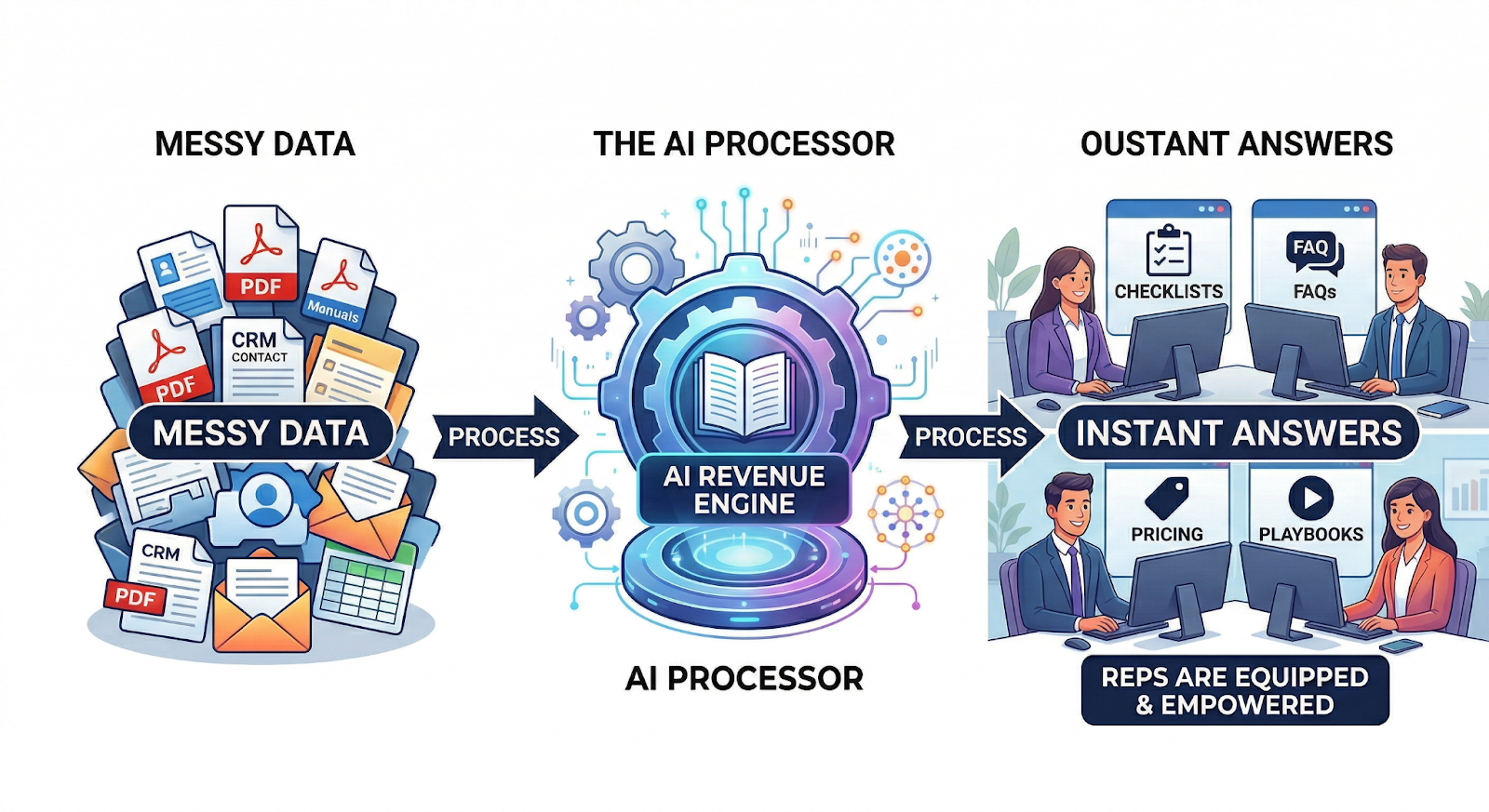
This is where source-grounded AI systems like Google’s NotebookLM start to change the equation. NotebookLM is an AI tool that uses your company’s own documents to answer questions, surface insights, and make internal knowledge easy to access. They do not rely on generic internet data. They use your internal documents as the source of truth.

How AI Improves B2B Knowledge Transfer for Sales and Service
Let’s break this down in practical terms.
1. Faster Onboarding Without Bottlenecks
New sales and service reps often face a steep learning curve. They need to understand products, positioning, pricing, and customer expectations quickly.
Traditionally, this means shadowing senior team members or digging through outdated folders.
With a structured digital language model system:
- Reps can ask direct questions and get immediate answers
- Responses align with your current messaging and documentation
- Senior team members are no longer the bottleneck
Example question an onboarding rep might ask:
- What is the difference between Product A and Product B for healthcare applications?
- What are common objections during quoting?
Instead of waiting hours or days, they get a clear, sourced answer in seconds.
2. Turning Technical Content Into Usable Training
Most industrial companies have strong technical documentation. The problem is usability.
Dense manuals and service logs are hard to learn from, especially in real-world situations.
AI can restructure that content into formats that teams can actually use:
NotebookLM can transform technical documentation into:
- Product training guides
- Step-by-step service procedures
- Troubleshooting checklists
- Internal FAQs
- Product comparison charts
This is where knowledge transfer becomes practical instead of theoretical.
It also supports different learning styles. A field technician might need a quick checklist. A sales rep might need a simplified explanation. The same source content can serve both.
3. Building a Central Source of Truth
One of the biggest risks in B2B organizations is knowledge loss.
When experienced employees leave, they take years of insight with them. Pricing nuance, customer history, and decision patterns often disappear. According to Strivr, approximately 90% of the total knowledge in an organization is held in employee expertise and undocumented forms.
A centralized knowledge system changes that.
Teams can:
- Upload past project data and customer interactions
- Analyze patterns in wins and losses
- Identify recurring customer pain points
Over time, this becomes a proprietary asset. It is not just documentation. It is a competitive advantage.
As outlined in the draft, organizations that centralize this intelligence turn everyday operational data into a long-term strategic asset.
Key Lessons for Building a Knowledge Transfer System That Works
1. Knowledge Transfer Is a Revenue Lever, Not an Ops Task
Most teams treat documentation as a back-office function. That is a mistake.
When sales reps have faster access to accurate information, they close deals faster. When service teams solve problems more quickly, customer satisfaction improves.
Knowledge transfer directly impacts pipeline and retention.
2. AI Is Only as Good as the Data Behind It
Generic AI tools struggle in technical industries because they lack context.
Source-grounded systems solve this by restricting answers to your internal data. That improves accuracy and builds trust across teams.
The takeaway is simple. Do not start with the tool. Start with your data.
3. Structure Beats Volume
More content does not equal better knowledge transfer.
What matters is how information is organized and accessed. A smaller, well-structured knowledge base will outperform a massive, unorganized one every time.
4. This Is a System, Not a One-Time Project
A knowledge base is not something you build once and forget.
It needs to evolve with:
- New products
- Updated processes
- Market changes
The companies that treat it as a living system will stay ahead.
How to Start Building a B2B Knowledge Transfer System
If you are starting from scratch, keep it simple.
Step-by-step approach:
- Collect internal documentation such as manuals, SOPs, and playbooks
- Upload content into a source-grounded AI environment
- Organize content into clear categories by function
- Test real-world queries across teams
- Maintain and update the system over time
Do not try to boil the ocean, as they say. Start with one department, prove value, then expand.
Reflection: Why This Matters for Evenbound Clients
Most of the B2B companies we work with are not lacking expertise. They are struggling to scale it.
We see this show up in a few consistent ways:
- Sales teams rely on a few key individuals for answers
- Marketing creates content that does not align with real sales conversations
- Service teams solve the same problems repeatedly without documentation
This is not a content issue. It is a system issue.
When you connect your CRM, your content, and your internal knowledge into one accessible layer, everything improves:
- Faster deal cycles
- Stronger messaging consistency
- Better onboarding
- More confident teams
If you are already investing in HubSpot, paid media, and content, this is the layer that makes those investments perform better.
For more on how we approach connected systems, check out our How to Implement RevOps strategy framework.