Search, buying behavior, and customer expectations have all changed — and your marketing strategy has to change with them.
In 2026, buyers don’t move through a neat little funnel. They bounce between AI search results, social feeds, YouTube deep dives, comparison pages, and your pricing page… all before your sales team even knows they exist. And when you finally do show up in their world? They expect you to already understand what they’re struggling with.
That’s why traditional marketing plans aren’t cutting it anymore — and why the brands winning right now are the ones building full-funnel marketing strategies that feel personal, cohesive, and built for real buyer behavior.
In this blog, I’ll break down what a full-funnel strategy actually is, why personalization sits at its core, and how HubSpot and AI make it possible to scale this approach without burning out your team.
What Is a Full-Funnel Marketing Strategy (In 2026)?
At its core, a full-funnel marketing strategy is a unified revenue system — one that connects every stage of the buyer and customer journey and aligns Marketing, Sales, and Customer Success around a single story.
It covers:
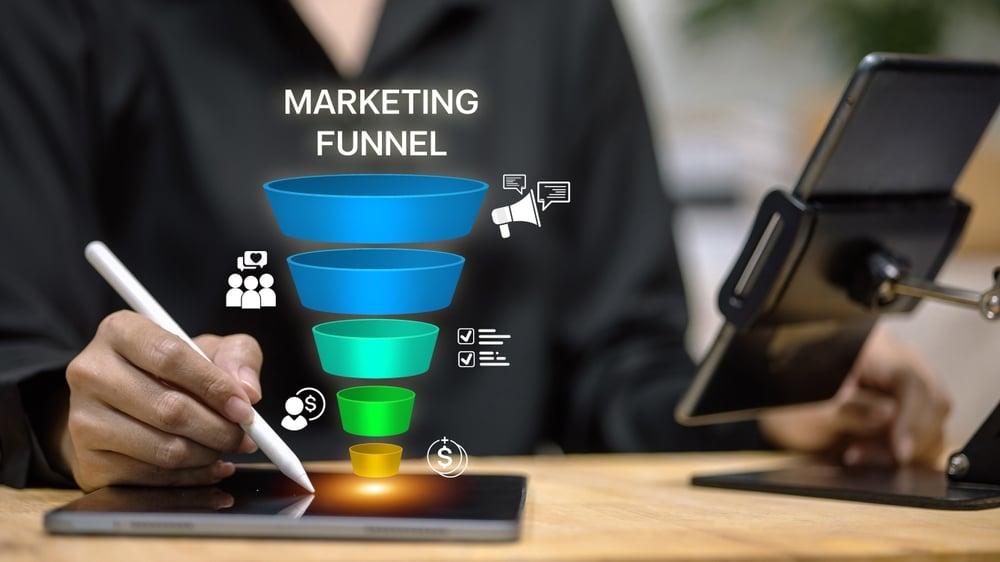
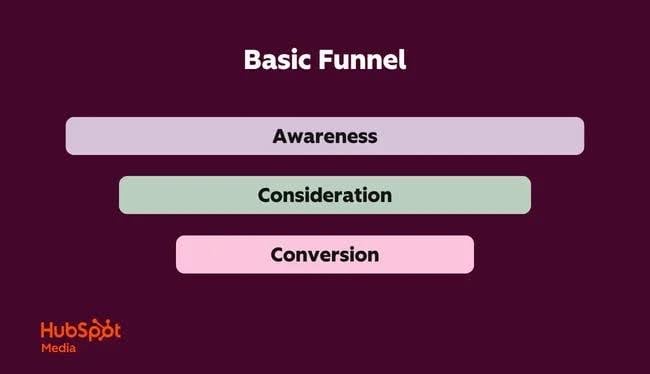
- TOFU (Top of Funnel): Demand creation + AI-discoverable content
- MOFU (Middle of Funnel): Intent-driven engagement + personalized nurture
- BOFU (Bottom of Funnel): Sales acceleration + role-specific messaging
- Retention: Onboarding, adoption, renewal, expansion
- Automation & Attribution: The glue that keeps teams aligned
Think of it as the operating system for your go-to-market strategy.
It’s not a campaign.
It’s not a handoff.
It’s not a sequence.
It’s the strategy that makes everything else work.
And yes — personalization isn’t just part of the strategy. It’s the throughline.
Traditional Funnels vs. Full-Funnel Strategy: What’s Changed
Most teams still operate like it’s 2014 — treating the funnel as linear and marketing-led. But that world doesn’t exist anymore.
Here’s how the shift looks:
|
Traditional Marketing Strategy |
Full-Funnel Marketing Strategy (2026) |
|
Campaign-based |
System-based |
|
Generic messaging |
Personalized, pain-led messaging |
|
Linear buyer journey |
Nonlinear, behavior-driven journeys |
|
KPI = traffic + leads |
KPI = pipeline, conversions, retention |
|
Marketing-focused |
Marketing + Sales + CS alignment |
|
Manual work |
Automation + AI acceleration |
The takeaway?
If your funnel isn’t built around how humans actually buy today, you’re already behind.
What Personalization Actually Means in 2026 (And What It Definitely Doesn’t)
A lot of marketers still think personalization means:
“Hey , checking in…”
Let’s be honest — nobody is impressed by that anymore.
Buyers don’t want personalization theater.
They want relevance.
They want recognition.
They want you to show that you understand their problem.
Real personalization sounds like:
✔ “You’re trying to shorten your sales cycle — here’s how teams like yours are doing it.”
✔ “Noticed you revisited the pricing page — here’s the ROI breakdown for your industry.”
✔ “Directors of Ops usually struggle with XYZ. Here’s how others have fixed it.”
This is the type of personalization that drives conversions.
And with HubSpot AI, it’s now scalable — not manual.
Where Funnels Break (And Why Mapping Fixes It)
Most funnels don’t break at the top. They break in the in-between moments nobody audits:
- MQLs → ignored
- Pricing page views → no follow-up
- Demos → poor handoff
- Closed-won → poor onboarding
- Customers → churn because no one followed up
Mapping your buyer journey exposes this friction — and becomes the blueprint for your personalization strategy.
You’re not guessing anymore.
You’re designing around the real journey, not the ideal one.
Your GTM Strategy and Your Funnel? They’re the Same Thing.
Here’s a hard truth:
Your full-funnel strategy is just your GTM strategy in motion.
If your GTM says you target mid-market manufacturing teams, but your messaging still sounds like generic B2B advice, your funnel is misaligned from the jump.
Alignment is the unlock:
- Shared ICP
- Shared messaging
- Shared lifecycle stages
- Shared success metrics
- Shared POV across every stage
- Shared expectations between Marketing → Sales → CS
This is where most companies fall apart — and where your advantage begins.
The 5 Components of a Full-Funnel Marketing Strategy in 2026
Below are the five interconnected parts of a modern, full-funnel strategy — each one aligned with real buyer behavior, built for personalization, and powered by HubSpot and AI.
1. TOFU — Demand Creation Buyers Can Actually Find
Build AI-discoverable content that answers real buyer questions, establishes authority, and shows up where modern buyers search.
AI search changed everything.
People aren’t discovering content through keywords — they’re discovering content through questions.
Your TOFU content must:
- Answer buyer questions directly
- Build topical authority
- Be structured clearly enough for AI to cite
- Speak to pain by role or industry
- Lean heavily on video + POV
TOFU Personalization Example:
A Director of Ops searching “reduce manual workflows” should lands on content framed specifically for their operational pain — not a generic article about automation.
2. MOFU — Where Most Personalization Dies
Use behavior-driven triggers — not timers — to personalize nurture based on what the buyer is actually doing.
Most nurture strategy today is:
“Send four generic emails and hope for the best.”
But MOFU is where intent becomes clear — if you know how to capture it.
Modern MOFU personalization means:
- Triggered by behavior, not timers
- Dynamic content blocks by role
- Nurture mapped to pain, not persona
- AI-assisted rewrites for tighter personalization
- Messaging that adjusts to what they’ve viewed, not what they downloaded
MOFU Personalization Example:
They revisit your pricing page → your system shifts them to BOFU messaging automatically.
Not in a week.
Not after three emails.
Immediately.
3. BOFU — The Moment Personalization Matters Most
Tailor BOFU content by role, industry, and behavior so buyers trust you more than the other tabs they have open.
At BOFU, buyers are trying to decide:
“Do I trust you more than the other four tabs I have open?”
Your BOFU personalization should include:
- Role-based content (CFO vs Ops vs IT)
- Industry examples
- Team-size considerations
- Personalized talk tracks
- Behavior-driven sales follow-ups
BOFU Personalization Example:
Sales gets an AI-generated summary of the account’s behavior before every call — with recommended objections they’re likely to have.
That’s personalization that wins deals.
4. Retention: The Growth Multiplier No One Talks About
Support onboarding, adoption, renewal, and expansion using automated, behavior-based personalization.
Retention isn’t a nice-to-have — it’s your most reliable revenue lever.
Personalization here looks like:
- Onboarding by use case
- AI-powered product adoption nudges
- Renewal reminders tied to engagement
- Customer success insights surfaced automatically
This is how you turn customers into advocates — and stretch your LTV without stretching your team.
5. Automation Doesn’t Replace Personalization — It Enables It
Automate the operational backbone (routing, lifecycle, follow-ups, and attribution) so your team can focus on real personalization.
When teams automate:
- Lead routing
- Lifecycle updates
- Speed-to-lead follow-ups
- Renewal workflows
- Attribution corrections
…they free up the time needed to actually write relevant messaging.
AI accelerates workflow building.
Automation removes human delay.
Personalization becomes natural.
This is where HubSpot becomes your growth engine.
Why Funnels Alone Aren’t Enough — Enter LOOP Marketing
The truth is, even the modern full-funnel model has a limitation: it ends.
But your customer relationship doesn't.
That’s where LOOP Marketing comes in.
Instead of viewing your buyer journey as TOFU → MOFU → BOFU → done, a LOOP-based strategy assumes:
- Buyers re-enter at different stages
- Engagement isn’t linear
- Retention and expansion feed new acquisition
- Every action becomes a trigger for the next
LOOP Marketing reflects what’s actually happening today:
- A customer reads a blog post after buying
- A prospect sees a case study before ever talking to sales
- A long-term customer attends a webinar and becomes expansion-ready
- A lost deal resurfaces after reading a pricing update
Nothing is linear anymore — everything loops.
And when you combine LOOP Marketing with a full-funnel strategy, you get a system that’s:
- Continuous
- Behavior-driven
- Personalized
- Revenue-centered
- Predictable
- AI-enhanced
- Scalable
This is the model Evenbound uses today with clients because it mirrors how buyers move and how revenue is actually created.
90-Day Experiments: The Most Underrated Growth Strategy of 2026
Funnels are not static. They’re living systems.
The fastest-growing teams run quarterly experiments across:
- TOFU content
- MOFU nurture paths
- BOFU talk tracks
- Retention messaging
- Email + CTA variations
- AI-generated copy vs human copy
- Pricing page optimizations
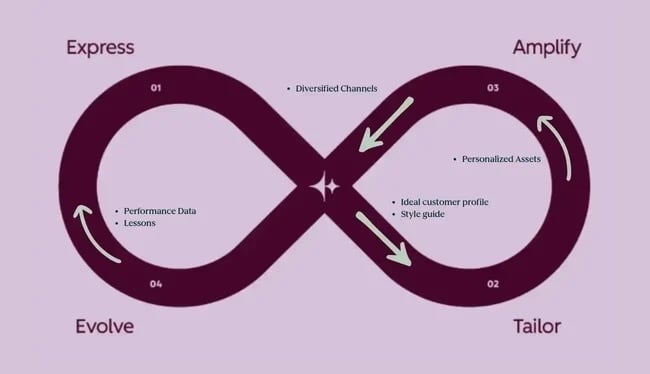
Experiment → learn → optimize → scale.
That’s how full-funnel strategies stay alive.
Key Takeaways
- Personalization is the new performance driver.
Generic messaging kills funnels. Precision drives conversions.
- AI is the accelerator — not the strategist.
It scales personalization but doesn’t replace your judgment.
- Alignment is everything.
Marketing, Sales, and CS need one story, one journey, one strategy.
- The funnel isn’t linear anymore.
Your systems must adapt to nonlinear, AI-influenced decision making.
Why This Matters for Evenbound Clients
This is exactly the work we do every day.
We help clients build full-funnel marketing strategies that are aligned, personalized, automated, and built for how people buy right now.
When you get this right:
- Your pipeline becomes predictable
- Your sales team closes faster
- Your customers stay longer
- Your entire org finally pulls in the same direction
That’s the power of a real full-funnel strategy.
Ready to Build a Full-Funnel System That Actually Feels Human?
Nobody wants to feel like they're in a funnel.
They want to feel understood.
A modern full-funnel strategy is how you make that happen — at scale.
Want help building yours? Let’s talk.
Evenbound specializes in full-funnel systems that actually work.