|
Quick Answer: What Is a Customer Health Score in HubSpot? A customer health score in HubSpot is a weighted scoring system that combines engagement, support, commercial, and qualitative relationship signals to predict customer churn, renewal likelihood, and expansion opportunities. |
Most B2B companies don’t realize a customer is at risk until the renewal stalls, the reorder disappears, or leadership gets pulled into an escalation call.
By then, it's late.
A customer health score gives you a leading indicator instead of a lagging one, similar to how predictive lead scoring works for B2B sales. Built right inside HubSpot, it turns the signals you already have (engagement, support tickets, contract data, sentiment from notes and meetings) into a single number that tells your team which accounts to lean into and which need attention now.
Let’s walk through what a customer health score actually is, why HubSpot is missing half the signals you need by default, how to build the score step by step, and the mistakes that make most scoring systems collapse within a quarter.
What Is a Customer Health Score?
A customer health score is a composite metric that combines behavioral, qualitative, and commercial signals into a single metric that estimates a customer's likelihood to renew, expand, or churn.
It's not a satisfaction survey result, and it's not a gut feel. It's a weighted formula your team agrees on, applied consistently across every customer in your CRM. The point isn't to be perfectly precise (in fact, you’ll probably find that you need to tweak it on a quarterly basis). The point is to give your team a shared way to spot trouble (or opportunity) early, before it shows up in revenue.
This matters more in B2B than in B2C. Sales cycles are longer, contract values are higher, accounts are fewer, and renewals or repeat orders depend on relationship strength as much as product performance. Losing a single key customer can mean rebuilding the pipeline for a quarter.
|
Customer Health Score Tracks |
Traditional Reporting Tracks |
|
Churn risk |
Past renewals |
|
Relationship sentiment |
Closed revenue |
|
Account engagement trends |
One-time activity |
|
Expansion likelihood |
Historical performance |
|
Customer risk signals |
Lagging indicators |
|
Stakeholder engagement |
CRM data only |
What Metrics Should Be Included in a Customer Health Score?
Out of the box, HubSpot tracks behavioral signals well: email opens, last contact date, ticket volume, deal stage. What it doesn't track, at least not by default, are the qualitative signals that often matter more in B2B: how a customer feels about the relationship, whether you're hitting their timeline expectations, and how productive your meetings actually are.
The fix is to build custom properties that turn those qualitative factors into something you can score. Three we've found as a great starting point:
Sentiment rating (1-5 scale). Updated by the account owner after key touchpoints. Captures the relational temperature that no email response rate will ever show. A customer can reply to every email and still lose trust.
Timeliness rating (1-5 scale). How well your team is hitting the deadlines and turnaround times the customer expects. This is often the leading indicator that gets ignored. By the time a missed deadline shows up as a complaint, you're already in the yellow.
Meeting outcome rating (1-5 scale). Logged after each call or QBR. Were the right people there? Did decisions get made? Did the customer leave engaged or distracted? Three "meh" meetings in a row is a signal worth acting on.
The trick is formatting qualitative judgments in a quantitative way. A 1-5 rating forces the account owner to make a call, and once it's a number, it can be weighted into a score and watched over time.
The behavioral signals HubSpot tracks natively still matter and should sit in your score. But pair them with the qualitative properties above, or you'll end up with a score that's easy to game and slow to react.
A quick rundown of the native categories worth including:
- Engagement signals (Marketing Hub / Sales Hub): email replies from key contacts, meeting frequency, last contact date, product or content engagement. For manufacturers, this often means portal logins, quote requests, and reorder frequency. For SaaS teams, it's feature usage pulled in through integrations.
- Support and service signals (Service Hub): open ticket count and age, time to resolution trend, NPS or CSAT responses.
- Commercial and relationship signals (HubSpot CRM): contract value and tenure, multi-threading (how many contacts per account are actually engaged), stakeholder turnover, deal stage progression on expansion opportunities.
Example Customer Health Score Criteria for B2B Companies
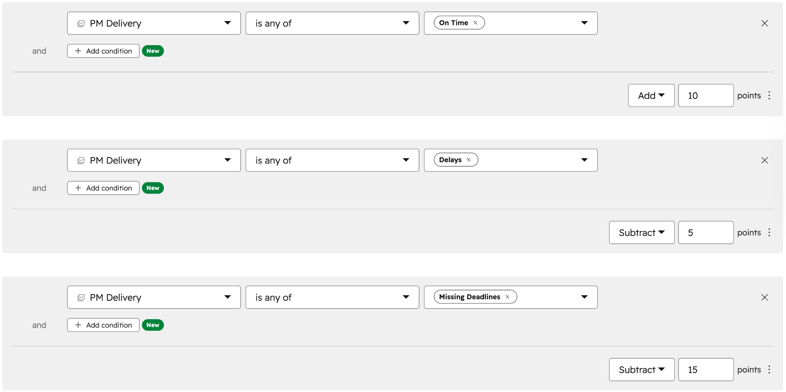
The exact signals included in your customer health score should reflect what actually predicts churn, renewals, and expansion opportunities in your business. While every company will weigh signals differently, most strong B2B customer health scores combine operational, relationship, engagement, and commercial data.
Here are some common customer health score inputs B2B teams track in HubSpot:
- Last order date: How recently the customer placed an order or renewed a contract.
- Reorder frequency: Whether purchasing behavior is increasing, stable, or slowing down over time.
- Meeting participation: Attendance and engagement during QBRs, strategy calls, or customer check-ins.
- Stakeholder turnover: Changes in leadership or key contacts that may create risk within the account.
- Open ticket aging: The volume and age of unresolved support or service issues.
- Expansion opportunity stage: Whether the account is actively discussing upsells, renewals, or new projects.
- Sentiment score: A qualitative rating based on account owner feedback after meetings or interactions.
- Executive engagement: Participation from decision-makers and leadership contacts within the customer account.
- Response time trends: How quickly customers reply to emails, approvals, or requests.
- Contract value and tenure: The size and longevity of the customer relationship.
- Multi-threading strength: The number of active relationships your team has within the account.
- Product or portal usage: Engagement with customer portals, software platforms, or self-service tools.
The goal is not to track every possible metric. It’s to identify the handful of signals that consistently indicate whether an account is healthy, at risk, or ready for expansion.
How To Build a Customer Health Score in HubSpot Step-by-Step
Once you know what to track, the build itself is straightforward. Eight steps:
- Define what "healthy" means for your business. A healthy or “green” account for a manufacturer (reorders on schedule, multiple plant contacts engaged, strong timeliness rating) looks different from a green SaaS account (usage trending up, expansion conversation open, strong sentiment rating). Write down what green, yellow, and red look like before you build anything.
- Build your custom properties first. HubSpot doesn't come with sentiment, timeliness, or meeting outcome ratings, but those are often the most valuable inputs. Create them before you create the score. Standardize the scale and write a short internal definition for what each number means, so ratings stay consistent across account owners.
- Pick 5-8 signals total. More is not better. Mix behavioral, qualitative, and commercial. Start small and refine quarterly.
- Weight them. Qualitative signals might be 35%, behavioral 25%, commercial 25%, support 15%. Your numbers will differ based on what actually predicts churn in your business. (Hint: you can absolutely use AI to help with your weighting decisions and adjust down the road).
- Build the score in HubSpot. Use a score property for simple point-based scoring, or a calculated property when you need a formula that references other properties. Score properties are easier to maintain; calculated properties give you more precision.
- Display it on the company record. Make it visible to anyone who opens the account. A score nobody sees is a score nobody uses.
- Gut check your scores. Once you have scoring live, poke through a few of your company records. Does it make sense that ACME Co. is in the red, despite them reordering on a weekly basis and they just gave you a 5-star Google review? Do you have XYZ Corp. been considered healthy despite them emailing monthly about a delayed shipment? These are glaringly obvious examples, but you should be able to walk away from your new score implementation saying “Yeah, that makes sense for them.”
- Set automations. Once you feel comfortable with the scores, you should trigger workflows when a score crosses a threshold: a task to the account owner, a Slack alert, an internal note for leadership. This can be for both healthy and at risk accounts. Healthy accounts might be worth exploring as an expansion opportunity, whereas your at-risk companies may be worth a proactive call to resolve any issues.
4 Common Customer Health Score Mistakes To Avoid
1. Treating it as a one-time build
Customer health scoring is a living system. The signals that mattered a year ago may not matter now. Review and reweight quarterly.
2. Building the score before defining the action
A health score that nobody acts on is just a number. Define the action for each score band (green = expansion conversation, yellow = proactive check-in, red = escalation to leadership) before you finalize the formula.
3. Over-weighting engagement, under-weighting commercial and qualitative signals
Email opens are easy to track but easy to fake. A customer can open every email, sit through every meeting, and still not reorder. Balance behavioral signals with the qualitative ratings and commercial behavior that show real intent.
4. Letting ratings drift across account owners
If your sentiment rating means something different to every account owner, the score is unreliable. Document what each number or rating on each scale means, calibrate as a team once a quarter, and review outliers together.
Why This Matters for B2B Teams in 2026
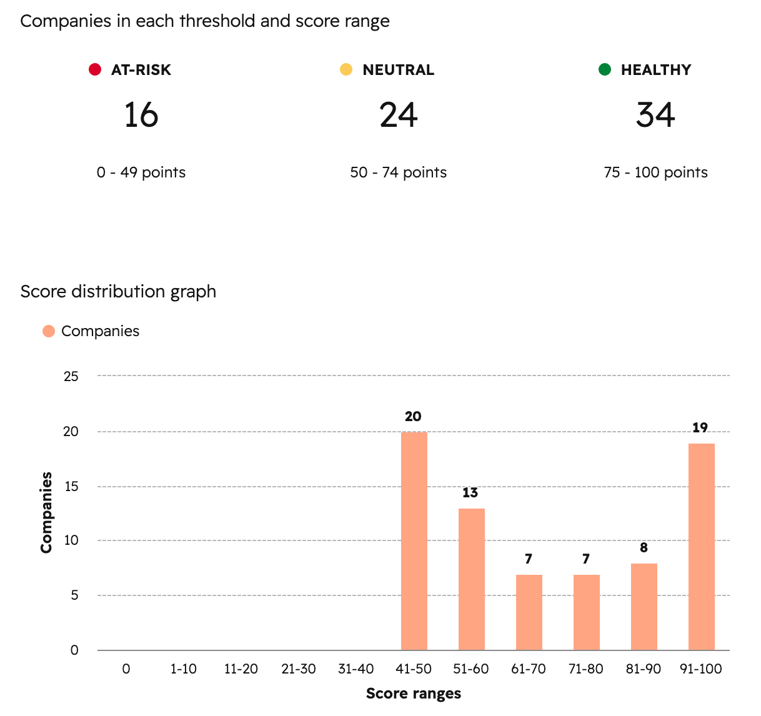
For B2B companies, especially in manufacturing and tech, the cost of losing a key account is rarely just the lost revenue. It's the lost expansion, the referral that never happens, and the team time it takes to backfill the pipeline. A customer health score doesn't prevent churn on its own, but it gives your team a shared language and an earlier warning system.
At Evenbound, we built sentiment, timeliness, and meeting outcome properties into our own client health score because we kept seeing accounts trend yellow on the relationship long before they ever showed up as yellow on the dashboard. The native HubSpot signals told us what customers were doing. The custom properties told us how they felt about it. That second layer is where most B2B health scores need to grow.
The right health score is the one your team will use, trust, and act on every week.
Checklist: Signs Your Customer Health Score Is Actually Working
A customer health score should help your team make faster, more proactive decisions, not create another dashboard nobody uses.
Here are a few signs your health scoring system is working effectively:
 Teams trust the score and reference it regularly Red accounts trigger proactive outreach before renewals are at risk Expansion opportunities surface earlier in the customer lifecycle Leadership can identify churn risk without digging through multiple systems Customer success teams prioritize accounts more confidently Sales, service, and account management teams share a consistent view of account health Score trends align with actual renewals, retention, and churn outcomes Teams take action based on score changes, not just static reports Qualitative relationship signals are improving visibility beyond CRM activity alone Account owners can explain why an account is green, yellow, or red
The best customer health scores are not the most complicated. They’re the ones your team consistently trusts, reviews, and acts on.
Turn Your Customer Health Score Into a Retention System
A customer health score is most valuable not as a metric, but as a habit. The teams that use it well aren't the ones with the most sophisticated formula. They're the ones who look at it consistently and act on what it tells them.
Want to build a customer health scoring system that actually reflects how your customers behave, buy, and renew?
Evenbound helps B2B teams design HubSpot systems that connect operational data, relationship signals, and customer activity into a health score your team can trust and act on.
Reach out to Evenbound today to get started.